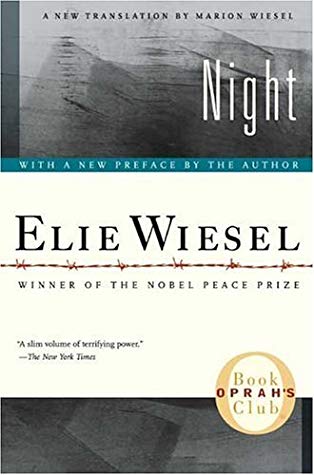
Everyone was talking about this book. Just consumed it. Now I grasp mentally what this night was. The title of this book is Night. And the story that follows is also as dark as a night. A pitch-dark night! And when I conclude the book, I recall a few lines of Octavio Paz, at the beginning of the review.
“Lightning or fishes
OCTAVIO PAZ
In the night of the sea
And bird lightning
In the forest night
Our bones are lightening
In the night of the flesh
O world! All is night
Life is the lightening”
The problem is that the story inside the title night is real, rather than fictional and this is the biggest plight. The anguish and horror in this book are not just of suffering, arising out of one person Eliezer. It is a universal pain. This book is a very intimate, firsthand account of a survivor’s perspective that was recorded in his memory permanently, inside the Nazi death camp at Auschwitz and Buchenwald.
In the book, those horrifying events, which are narrated from the viewpoint of a teenage boy who suffered personal losses, seem mostly true to the core and it is very scary. It’s really petrifying and I can’t imagine someone had done such things to human beings. A bunch of human beings treating another bunch of humans like animals, like lifeless stuff, filling them into a cattle car and jostling them hard like mules. Not leaving even infants. Horrible!
“Without passion or hate prisoners were forced to approach the trench one by one and offer their neck. Infants were tossed into the air and used as targets for the machine guns.”
NIGHT
I know well enough of Holocaust. But this is my first try of any such intimate account on it. This year I have already begun many other books revolving around WWII and Nazi stuff. And with this one, it’s a ghastly opening, very grim emotions it has produced in me.
While the book is about a very heinous and unfortunate historical wrongdoing, a shame on human civilization, the author has made an extremely legible piece of work for the general reader, the original manuscript was written in Yiddish, and is translated quite well in English. The book also shows the writerly craft of the author where he has been able to bring on the tender and heart-touching emotions between the characters with regard to friendships and father-son relations.
“While forced to do work under various kommandos, boys from different places came together and quickly became friends. They knew countless Hebrew songs and so we would sometimes hum melodies about walking the gentle waters of the Jordan River and the Majestic sanctity of Jerusalem.”
NIGHT
The boy is very possessive of his father and wishes to keep himself with him all the time, even in the time of death. He just wants to be close to his father irrespective of whatever happens next.
“I ran to look for my father he was leaning against the wall bent shoulders sagging as if under a heavy load. I went up to him took his hand and kissed it I felt a tear on my hand. Whose was it? Mine? His? I said nothing. Nor did he. Never before had we understood each other so clearly.”
NIGHT
A young boy inside the concentration camp asks his friend that his turn is next and now he will be dead in a few days and thus he counts his days.
“In three days I will be gone, say Kaddish for me.
NIGHT
We promised: in three days when we would see the smoke rising from the chimney we would think of him. We would gather ten men and hold special service. All his friends would say Kaddish.”
The power of Wiesel’s story and its engaging narration has taken me aback, how clearly he has overpowered me as a reader, through his very intense storytelling artistry of a very personal account of his life. One of the most important things that I kept on noticing everywhere is the numinous undertone in the dialogues between the characters. It divulges the spiritual aspect of whatever happened with his life. An incorporeal elucidation!
This book raises many questions, most of them remain unanswered.
“He explained to me with great emphasis, that every question possesses a power that was lost in the answer…”
NIGHT
19th Century 20th Century Adventure Africa American Asia Booker British Literature Children Classic contemporary Crime Detective Drama Essays fantasy French Literature German Literature Gothic Historical Fiction Horror Humor India Indian Literature magical realism Memoir Music Mystery Nature Netgalley Nobel Prize Non Fiction Novel Novella Philosophy Play Poetry Race Romance Russia Russian Literature School Short Stories War Women

 BOOKBROODER