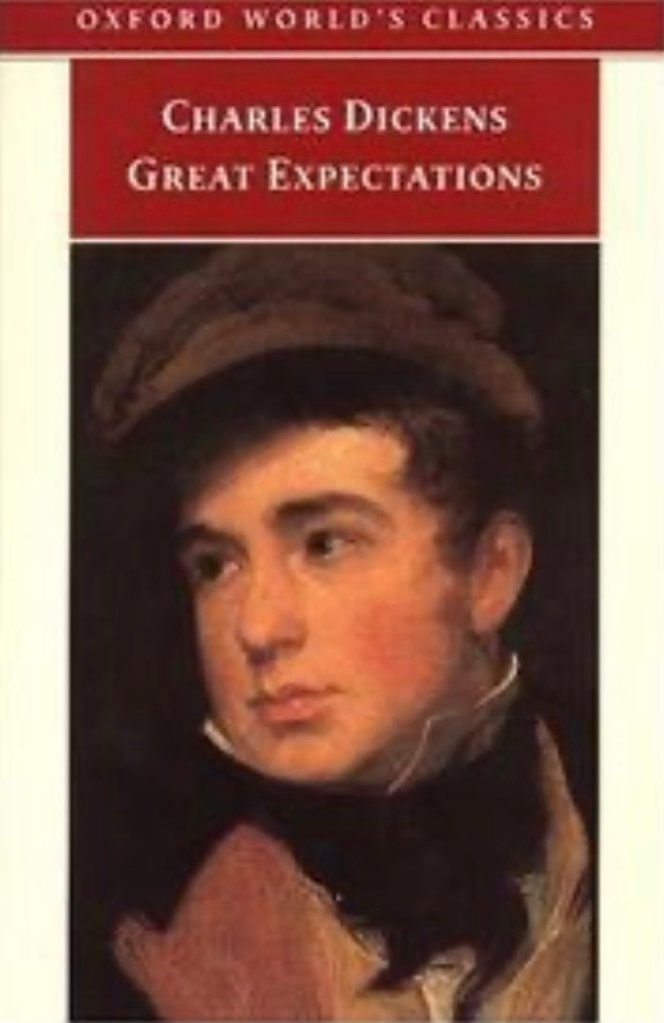
Great expectation was my first book of Dickens. Years ago when I read it, I could not possibly understand its importance from the perspective of social injustice and class conflict of that time. I remembered that initial self-introduction of a young boy, where he talked about his family names and discussed why he preferred himself to be called Pip and not Philip.
I still had a fresh picture of how one day suddenly Pip encountered that fearful man, who was soaked in water, and smothered in mud, and lamed by stones, and stung by nettles. Who limped, shivered, glared and growled and cried in a terrible voice…
“Keep still, You little devil, or I’ll cut your throat!”
Another image that was still persisting in my mind was that of Miss Havisham, who lived in a dilapidated house. Where in a dreary room, which was faintly lighted by candles, speckled legged spiders running home on that table cloth darkened with black fungus, mice rattling behind the panels, and she with a hand upon Pip’s shoulder, leaning on her crutch headed stick, pointing to that big table saying …
“This is where I will be laid when I am dead. They shall come and look me here.”
I reread it, to recall what else had happened in Pip’s life, which I had partially forgotten. This time I could feel this dramatic work of Dickens with some maturity and totality. I could feel the constant inner struggle of Pip with his own conscience. Pip was ambitious and he constantly tried to become a gentleman. His purpose was to impress a young noble girl, Estella.
In fact, I grew with this story this time; I understood and reckoned many new themes. Themes of crime, class conflict, ambition, and guilt were more clearly comprehended by me. The imagery of Dickens has created some eternal and timeless characters in this book. I truly adored and approved this story yet again.
It just sprawled and quivered into me!
“I took her hand in mine, and we went out of the ruined place; and, as the morning mists had risen long ago when I first left the forge, so, the evening mists were rising now, and in all the broad expanse of tranquil light they showed to me, I saw no shadow of another parting from her.”
19th Century 20th Century Adventure Africa American Asia Booker British Literature Children Classic contemporary Crime Detective Drama Essays fantasy French Literature German Literature Gothic Historical Fiction Horror Humor India Indian Literature magical realism Memoir Music Mystery Nature Netgalley Nobel Prize Non Fiction Novel Novella Philosophy Play Poetry Race Romance Russia Russian Literature School Short Stories War Women
 BOOKBROODER