“You get born, and you nurse on lies, and you get weaned on lies, and you learn fancier lies in school. You live all your life on lies, and then maybe when you’re ready to die, it comes to you—that there’s nothing, nothing but yourself and what you could have done. Only you ain’t done it, because the lies told you there was something else.”
JOHN WILLIAMS
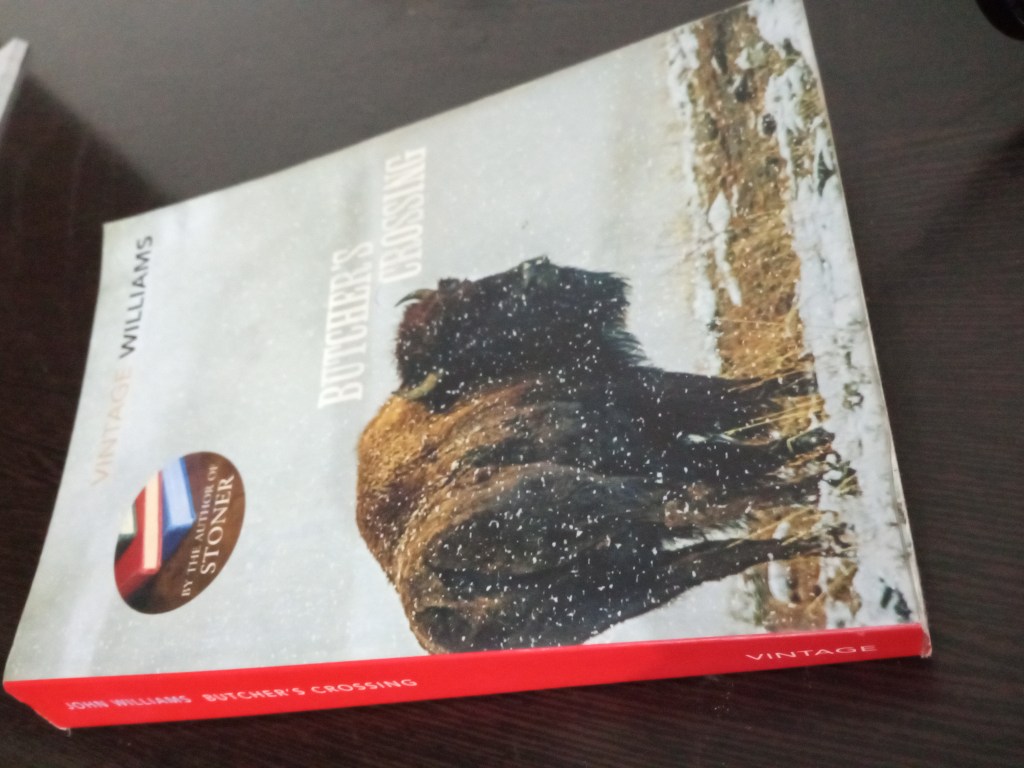
My copy of Butcher’s crossing has a red lining on the side and a big buffalo on the top. The buffalo, looking at me in a very unruly manner as if commanding me to shake off snowflakes from its thick hide. “Mr. Reader! Look at this. Touch it and feel its stringency. It’s going to be about this only. This hide. You know! This is more precious than those unreal inestimable calculations you do out there in the city, for your business stuff. It’s the real…My hide…The corporeal one!” It seemed to me as if the buffalo said this to me.
I was whetting my appetite for John Williams when I decided to go with this book. Bear with me. I have not yet read Stoner. I learned that this book was published five years before the Stoner. So I set my chronology right. Contrary to my expectations, in the first few pages, I could not discern I was reading an acclaimed author. Writing seemed to me rather simple and unadorned.
This book is about a hunting expedition. A young Harvard dropout William Andrews in his 20s goes to meet an experienced hunter called Miller to hatch this expedition in the beginning. Butcher’s crossing is a settlement in Kansas, and the year is 1873. Unhappy with his mundane affairs Andrews wants to explore the wilderness. He is a fan of Ralph Waldo Emerson. The hunter Miller, speaks about his past glories and about a discovery that thousands of buffalo graze there in the valley of a rocky mountain. He said that he discovered such a massive herd when he was once trapping beaver in Colorado. Andrews energized with the thought, exceeds his fears and approves the expedition.
They agree to go uphill and then downhill to their desired land, and a small cast of characters gathers around in the plot. A man called Schnieder is given the task of skinning and the other man Charles Hoge plays ‘cook and camp’. And there they go!
“In the early dawn, on the twenty-fifth day of August, the four men met behind the livery stable where their wagon, loaded with their six weeks provisions, waited for them, A sleepy stable man, scratching his matted hair and cursing mechanically under his breath, yoked their oxen to the wagon; the oxen snorted and moved uneasily in the faint light cast by the lantern set on the ground.”
Butcher’s crossing
The book slowly picks the pace and becomes more and more interesting with a steady build-up. I don’t like the violence against animals but the story did not at all care about my likings. The story turned out to be a lyrical blood-soaked tale.
A terrifying blizzard, these people face there and it was all unexpected. Dragging their wagon from one point to another and its riders hopping from one place to another, until all this become out of control. The adventures and survivalist prose were similar to what I found in Jack London tales It’s needless to say that I was compelled to have this comparison as I was recently engrossed in London’s snowy arctic adventures.
A prostitute Francine, who got attracted to Andrews is the only female character in the story and through her momentary relation with Andrews, the author has successfully conveyed the theme of refrain and restrain. He holds back the lust. The morality betrays his degradation, which was uncommon in the Butcher’s crossing. His senses were at times doomed with his inner conflict and with the sympathy for the murdered buffaloes. Destruction of something from within him that he observed as if from a distance. Gradually he came to look upon his frequent unions with Francine as if somebody else performed them.
“As if from a distance, sightlessly, he observed himself and his sensations as he fulfilled his needs upon a body to which, meaninglessly he attached a name. Sometimes lying beside Francine, he looked down the pale length of his own body as if it had nothing to do with himself;”
The prose is simple and elegant. The plight of Andrews, the sentimental undertone, and a few softer moments even in this blood-soaked tale, were some points I hark back to, even today. Sentences of the prose are clear and they have simple yet weighty aftereffects. I liked this book and I’ll hopefully soon be on the move to the Stoner.
A jar of instant coffee is brimming out there in the coffee parlor when I finish this review, but I have no plan to consume one, after posting it.
“Day by day he felt the skin of his face hardening in the weather in the stubble of hair on the lower part of his face became smooth as his skin roughened and the back of his hands reddened and then browned and darkened in the sun. He felt a leanness and hardness creep upon his body; he thought at times that he was moving into a new body or into a real body that had lain hidden beneath the layers of unreal softness and whiteness and smoothness,”
Butcher’s Crossing
19th Century 20th Century Adventure Africa American Asia Booker British Literature Children Classic contemporary Crime Detective Drama Essays fantasy French Literature German Literature Gothic Historical Fiction Horror Humor India Indian Literature magical realism Memoir Music Mystery Nature Netgalley Nobel Prize Non Fiction Novel Novella Philosophy Play Poetry Race Romance Russia Russian Literature School Short Stories War Women
 BOOKBROODER