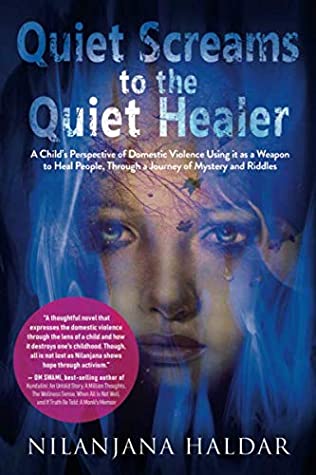
“If only I could see even a single moment of happiness between Mom and Dad. I’ve never seen them wrapped up in an embrace of love! I always feel something deep down inside of me cries out every time I see Mom and Dad fight—a howl reduced to nothing, unheard, or more like a throat-knot that I desperately want to push past for the rest of the night. I could yell every unaddressed howl from within and let it tear through the air into the clouds, and they wouldn’t end, believe me.”
This book talks about the agony of innocent childlike minds, which get filled with fear, insecurity, and self-dejection within the familial relationships after witnessing abuse and violence. Nilanjana, the debutant author of the book has made an effort to bring out a major yet less-spoken issue of dealing with domestic violence and household abuse. As per the author, the stories mentioned in the book are inspired by real-life events, made up further in the form of fiction. It is always tough to rate and review a book that is written for a purpose beyond that of mere storytelling. I would like to share my opinion though.
In the first part, the story is written from the perspective of an adolescent girl child, Sanjana, who keeps watching the domestic abuse from her father constantly. The piteous cries of her mother, impact the fragile mind of this young girl profoundly. She keeps her gloom up to her, affecting the psyche that leaves a long-lasting impression on her mind and sets up a future course of action for her as well. The main characters at the beginning of this story are Sanjana and Kirti. Both are classmates and close buddies, both have their own entanglements in their personal lives Sanjana is facing the dread of her father’s constant abuse and at times violence towards her mother. On the other hand, Kirti has around her the trauma, of her father’s critical chronic illness and medical condition. Observing abuse in her own family Sanjana goes in seclusion and she has a habit of writing to her imaginary friend Franny in a diary.
“I’m scared of your shouting, and I feel like running away. But I noticed that Mother feels the same. She feels like running away, too. I don’t understand, so I talk to Franny about it. We both agree it’s scary. Aren’t you scared of your own voice? I have a lot of growing left to do, so I rarely ask questions in class. I do hope someday my moral science teacher will explain the reasons to me.
I saw you beat Mommy in front of Grandmother. You may not have known, but I saw you do it. Probably, you never quite realized there could have been people around—your own princess, perhaps.
Beating is something I don’t agree with! How do you find it easy to take off your belt and snap it at my mother? I saw the marks. You hurt her badly. They were deep, red marks, and they looked angry”
The author has set the story in motion with the childhood events of school, picnics, forest trips with friends, minor and major events in school life, Christmas parties, her jolly relationship with her uncle, etc. There is a mysterious character called grandpa who in his earlier career came under the influence of the underworld and turned rogue. He later revamped himself and became a good man trying to be helpful to others. This character ‘grandpa’ seemed to me so annoying as he was appearing almost anywhere out of a sudden in the plot helping Sanjana. Only towards the end, I found the reason for his unusual appearance within the story.
The author has also portrayed how witnessing domestic abuse can make you determined to be positively transformed to do better for society after you overcome yourself. Sanjana personally engages herself with the suffering people after completing her medical degree, serving as a doctor. The author has also tried to bring the element of mystery and suspense through the introduction of seeing some mysterious “blue light” sequences in the story in the latter part. Relationships and issues in the marriage are also addressed.
So coming to the merit of the book first, I would consider first of all the writing of the author. The writing is lucid and the entire storyline has been written by the author in a very simple yet impressive language maintaining the dialogues and descriptive parts both quite coherent and reader-friendly, especially the part describing the school life and her relationships with Kirti. I liked more the descriptive part of the story where the author has been able to score high points using her well-crafted phrases. She maintained a flow.
Now here are some issues I have faced with this book.
The first one is about the length of the book, while in the frenzy of sharing all bitter and sweet stories with the readers, the author must keep one thing in mind that the reader should not feel that he has been put on some sort of additional obligation to read more than what is required for a satisfying reading experience.
The second observation of mine is when you sprinkle the element of fiction into a real-life story, for instance, suspense or any other made-up plots, like incorporating Gollum tribe, copper sulfate, blue light it must not look superficial for the reader, and it should look like in harmony with the main theme that is running in the backdrop.
The third thing I found is repetitiveness, a few things occurred again and again like those smarting and painful self conversations in the first part and those chase sequences by Sanjana in the childhood days first and again even after becoming a doctor starts chasing someone stealthily. It looked annoying for me, though I somehow liked whatever Sanjana did in those furtive chases.
For me the book had a good opening but became flat in the midway, a little bland; however, towards the end author had been able to resurrect some of my lost engrossment. I still feel the second part of the book could have been written with little more precision to turn into a more pleasing reading experience for me from the point of view of the story-spread and story-evolution.
However, I would say, despite not having a great storyline the author has impressed me with her writing skills and discerning methods in penning ordinary things happening around.
19th Century 20th Century Adventure Africa American Asia Booker British Literature Children Classic contemporary Crime Detective Drama Essays fantasy French Literature German Literature Gothic Historical Fiction Horror Humor India Indian Literature magical realism Memoir Music Mystery Nature Netgalley Nobel Prize Non Fiction Novel Novella Philosophy Play Poetry Race Romance Russia Russian Literature School Short Stories War Women
 BOOKBROODER