“That’s how it was when I was ten: nothing but trouble outside my head, nothing but miracles inside it.”
Years ago, I read Midnight’s Children. At that time I became a fan of Salman Rushdie’s writing style. His style was new to me and though I struggled a little bit with the prose, I still liked it. The word magical realism was not a new thing for me. Before Salman Rushdie, I had already read Ben Okri and Gabriel Garcia Marquez. As time permits, I have decided to talk about some books, I have read in the past.
I will begin with this one, Salman’s writing has both flavors; comical and sobriety. But I found him sober, that too in a very jocular way. He wrote funny sentences and made me laugh many times. His selection of words was also very emphatic and playful. I have found in the writing of Salman, ‘passion and pace’ both hand in hand. His passionate sentences, saying so many things all at once, packed together in long paragraphs which I felt sometimes, conveyed more to the reader, than what they were framed for. Some sort of- an overdose of literary pills, fed to a curious reader.
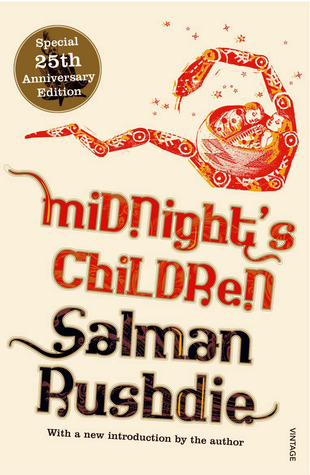
This is interesting to know that in 1993 this book was adjudged the “Booker of Bookers”, the best novel to have won the Booker prize in its first twenty-five years, It is claimed. How could I have grasped this thing at that time as my experience with the booker winning books has not been great so far! So, I will reserve my opinion on that but I must say that this book is an amazing book. Even if I found at some places, an inherent absurdity in the storyline, the imagination of the author and language was too exotic for me. I loved reading those passionate long paragraphs. The book was a wholesome cuisine for a hungry mind!
The other thing that I liked in the book is its politicization with respect to India’s certain socio-political history. It has broadened the horizon of the novel. And I am quite sure due to this amalgam, this book stands out. The author says in the beginning, that from the advanced money of his first novel, Grimus he decided to take a tour to India, and during the fifteen-hour bus ride the idea of midnight children was born, The year was 1975 and India had just become the nuclear superpower. So it inspired him to take up an ambitious plan to associate modern Indian history with the birth of a child.
“All games have morals and the game of Snakes and Ladders captures as no other activity can hope to do, the eternal truth that for every ladder you climb a snake is waiting just around the corner, and for every snake a ladder will compensate. But it’s more than that no mere carrot-and-stick affair because implicit in the game is the unchanging twoness of things; the duality of up against down, good against evil the solid rationality of ladders balances the occult sinuousities of the serpent in the opposition of staircase and cobra we can see metaphorically all conceivable opposition Alpha against Omega, father against mother here is the war of Mary and Musa and the polarities of knees and nose… but I found very early in my life that the game lacked one crucial dimension that of ambiguity – because as events are about to show it is also possible to slither down a ladder and climb to triumph on the venom of a snake… Keeping things simple for the moment however I record that no sooner had my mother discovered the ladder to victory represented by her racecourse luck than she was reminded that the gutters of the country were still teeming with snakes.”
MIDNIGHT CHILDREN
Those who live in the Indian subcontinent, or know well, its socio-cultural fabric and those who are aware of the politics of post-independent India, may feel a tie-in. Rushdie, with his passionate phrases, tried to narrate a magical story that is associated with the birth of a nation. He has portrayed some wonderful imagery beginning from Kashmir and then of his Mumbai days, the plot simultaneously traveling back and forth from Rawalpindi to Mumbai, involving the Pakistani army and India – China rivalry. The story is that some children are born near midnight of the day of independence of India and they all have magical powers. Salim Sinai, the narrator, is one among other 1000 children and he can read what is going on other’s heads, later got extraordinary power of smell.
“I tried to classify smells by color-.. I also had a geometric system: the roundness of joy and the angularity of ambition; I had elliptical smells, and also ovals and squares…”
I consider this book a significant add-on in my readings and enjoyed it most of the time. I will give the book full marks for its language, fancy, and temper. One should try this book once in one’s reading life because the book is so much of many things. The author has swaddled all masala tightly for the reader in his splendiferous technique.
Finally one rider, the book is bulky and it’s definitely not an easy read. I remember I had also tried it at least three times before finally gaining the momentum to finish it. So there are high chances that some people may take exception to this book for these two reasons!
“One peeps out of you and you are off to the guardhouse. If you want to stay, stay mum. Got it?”

“What’s real and what’s true aren’t necessarily the same.”
― Salman Rushdie
“Most of what matters in our lives takes place in our absence.”
― Midnight’s Children.
 BOOKBROODER