“She had a deep blue sac under one eye that was bloated like a bubble. As though her eye had tried to do what her lungs couldn’t. Some time close to midnight, the faraway man who lived in her chest had stopped shouting. A platoon of ants carried a dead cockroach sedately through the door, demonstrating what should be done with corpses.”
THE GOD OF SMALL THINGS
It does make some sense. Weather-wise or otherwise. To talk about this book today.
You cannot always remain dependent on weather, to post your thoughts on a story. You know all the big men are laltains (lanterns ), and the small men are mombattis (candles). This phrase I still remember. Lanterns and candles are always in demand whatever the weather outside. Isn’t it? They burn themselves and deliver shine to others. The last book I read was also about twisted candles! Candles are in the air, and a flame of flashback flares up in me!
So I read this book quickly again. Did someone read a book in peanut-crunching darkness? Anyone? I was reading it years ago in dark and was struggling to match up with the writing style of the author, initially. Read in dark means, not in the effulgence of electric light inside my room, but outside in the moonlight, with a punnet filled with peanuts in front of me. No pun intended. No cheesy wordplay; really, I had read pages of this novel, crunching peanuts, in the moonlight. I borrow this peanut–crunching expression from the author to describe my association!
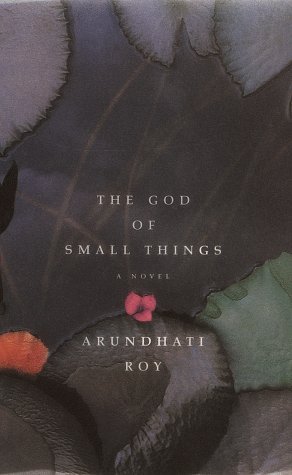
Today when I planned to revisit this book, some memories like a thin ribbon of thick water lapped wearily at the mud bank of my forgotten mind, in the very same way as Rahel had felt, when she had visited that river many years later. Another interesting fact, almost at the same time around when I was reading this book, I had visited for the first time, Kerala, ‘The god’s own country’. Almost 2722 km south of my place, I did some backwater boating there. Remember that the story in this book saunters in and around Kerala. A multi-generational Saga, with characters names like Chacko, Ammu, Pappachi, Mammachi, Kocchama, etc. And of course the twins, Rahel and Estha! How can you forget Sophie Mol and Velutha?
Arundhati’s way of describing a scene is brilliant, even if I was not in concurrence with the story; I was able to get impressed by the extremely lively portrayal of a scene in such clever language. She mastered herself throughout this craft. She does poetic justice even to the scenes which would otherwise be called so silly or even filthy.
In some pages her prose gave the feeling of reading the poetry of Whitman, see
“The grey old boatplant with boatflowers and boatfruit.
And underneath a boat-shaped patch of withered grass. A scurrying hurrying boatworld.
Dark and dry and cool. Unroofed now. And blind.
White termites on their way to work.
White ladybirds on their way home.
White beetles burrowing away from the light.
White grasshoppers with whitewood violins.
Sad white music.
A white wasp. Dead.”
The story and plot, everybody knows, for a booker winning book, so I won’t deliberate over that. The biggest issue is too much to and fro in the narration. It gave an acrid taste to the mouth of a reader and makes him struggle to keep things in line. It did not make this book a pleasing reading experience as far as the sequence of the plot was concerned. It was tough.
But writing is seraphic, passionate, delightful, and full of scenery. Among my so far, Booker-reads, I have found the passion of Salman Rushdie’s Midnight Children in the prose of Roy, the difference is, that Salman’s passionate prose resonates through long sentences and even longer paragraphs, but Roy’s passionate prose thrums in your ear in short sentences, sometimes rams into your head with one-liners. But she creates sensational fellow feeling through her words.
And an allegory, yes she is allegorical. Highly emblematic in her approach, in my eyes, she has taken up two grave issues untouchability and Marxism. And in both cases, she has successfully conveyed what she wanted to convey. This widened the book in scope.
The final thing I would say, though I was befuddled till the halfway and was not able to cope with the unarranged style of narration, there is a chapter eleven named ‘the god of small thing’, and from here onward this book starts to become clear and the narration becomes handy and the story starts revealing the real gospel, so wait till there if you face the same issue like me in narration.
“If he touched her, he couldn’t talk to her, if he loved her he couldn’t leave, if he spoke he couldn’t listen, if he fought he couldn’t win”
This book is assuredly an important read, but you need some patience!
In the beginning, it was panoramic, then it makes you emotional, then it gives you a chuckle, then it becomes childish and finally, it makes your eyes tear. The ending chapter is an ethereal beauty!
19th Century 20th Century Adventure Africa American Asia Booker British Literature Children Classic contemporary Crime Detective Drama Essays fantasy French Literature German Literature Gothic Historical Fiction Horror Humor India Indian Literature magical realism Memoir Music Mystery Nature Netgalley Nobel Prize Non Fiction Novel Novella Philosophy Play Poetry Race Romance Russia Russian Literature School Short Stories War Women
 BOOKBROODER