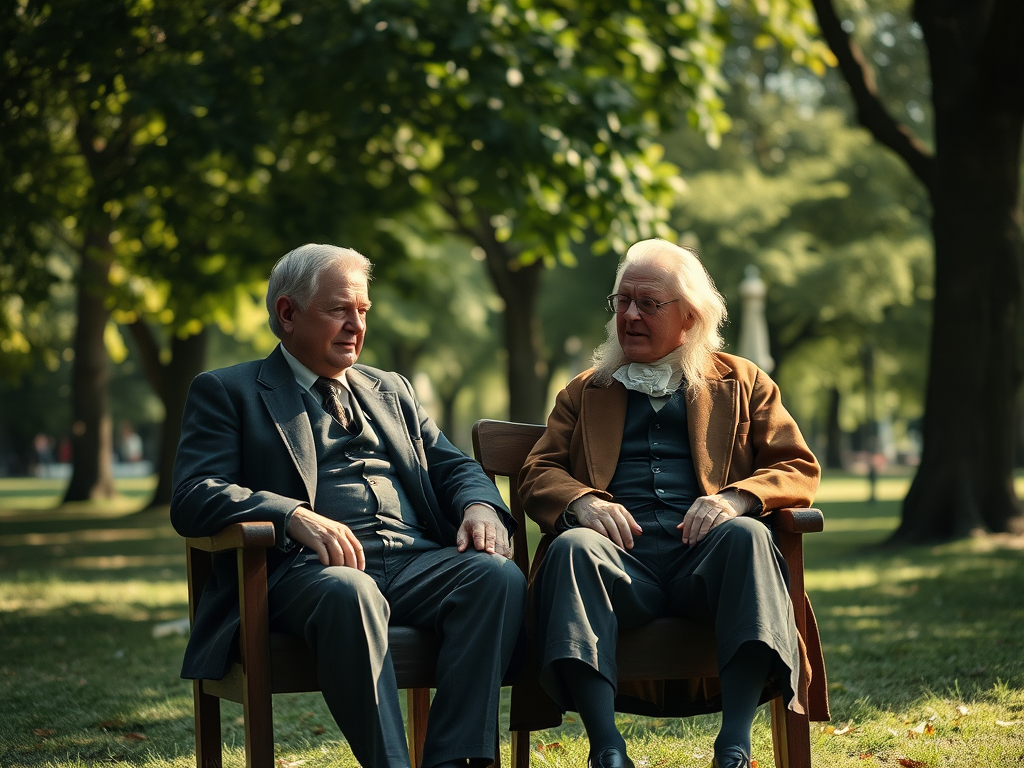
I read Orwell first and then Swift later in my life. However, on one fine day when I was biting an apple in a corner street, where everyone else was either having a cup of tea or coffee around me, I was definitely an outlier. But suddenly I realized that my companion was another outlier. It was a board, among the names of the various shops and their respective advertisements and offers. On this board, it was written “George was swift today!” I could never find out which George it was referring to!
And there it was – a cosmic pun that made me nearly choke on my apple (thankfully not a forbidden one from any dystopian orchard). That particular moment of serendipity made me realize something really profound: George Orwell and Jonathan Swift were, in my opinion, literary soulmates separated by a mere two centuries, both wielding their pens like surgical scalpels and not like swords, I must say, dipped in the most delicious poison. Delicious?Yes! You heard it right!
The Themes That Bind: Power, Corruption, and the Human Comedy
Both Swift and Orwell had a supernatural ability to look at the elephant in the room – or I should say, pig in the farmhouse? Their writing dances around the same central themes with the grace of a classical raga, each note building to create a symphony of social criticism on the previous. Power and her corruption are the backbone of the works of both writers. Swift’s Gulliver’s Travels presents us with petty political squabals of Liliputions, at which end should you crack your egg? A great metaphor to make any politician blush even today. Orwell’s Animal Farm gives us those famous immortal lines: “All animals are similar, but some animals are more similar than others.” In the context of today’s world, where the promise of equality often seems as elusive as finding a parking lot in Delhi, irony is particularly deeper and sometimes cut with more pain.
The theme of surveillance and control runs through their works like the Ganges through the plains – persistent and all-encompassing. Swift’s Laputans and their obsession with abstract mathematics, while completely ignoring practical governance, mirror our modern bureaucratic nightmares, while Orwell’s ‘Big Brother‘ concept feels uncomfortably familiar in an age of digital tracking. As Orwell warned, “Big Brother is watching you” – though in India, we might add, “and so are aunties from the neighboring building.” If you feel this is funny, I invite you to come to our neighborhood.
Human folly and undesired vanity receive equal treatment from both writers. Swift’s Yahoos in the fourth voyage of Gulliver represent humanity at its most base, while his Flying Island of Laputa satirizes the typical intellectual pretension. It indeed mocks at the very core of that false intellectualism. Orwell, on the other hand, shows us how quickly revolutionary ideals can transform into the very tyranny they sought to overthrow. Both authors understood that humans are remarkably consistent in their inconsistency – a trait one can witness daily during Mumbai local train rushes.
The Times They Lived In: Different Centuries, Same Human Nature
Swift lived through the ear-shattering, tumultuous days in the early 18th century, witnessing the Spanish succession, religious conflicts ,and the rise of party politics in the UK. His “A Modest Proposal “emerged from the devastating Irish famine and English indifference – a piece is such a great satire that it proposed to eat children to solve the problem of poverty, and when I first read it, it made me feel astonished. How can someone give such an idea? So inhumane! The initial line of the essay, “It is a sad object for those who pass through this great city or travel in the country, when they look at the roads, roads and cabin doors, crowds with beggars,” can still describe any major city roads. Indeed, it had created an instant visualization in my mind’s eye when I was going through it.
Orwell, who was writing in the shadow of two world wars, Stalin’s purges, and the rise of totalitarian regimes, had plenty of material for his dystopian nightmares. His impressions in Burma and then fighting in the Spanish Civil War shaped his worldview of power structures and the emergence of that propaganda politics all across the globe. 1984’s “War is peace. Freedom is slavery. Ignorance is strength” resonates particularly strongly even in this current era of “alternative facts” and ‘WhatsApp forwards’ that masquerade as real news and impact a larger audience.
Characters That Stick: From Talking Horses to Thoughtful Pigs
Swift’s genius can be witnessed in his creation of characters that were simultaneously absurd and also real. Gulliver himself is the perfect everyman protagonist – neither particularly heroic nor villainous, just profoundly human in his adaptability and occasional obtuseness. The Houyhnhnms, his rational horses, represent Swift’s ideal of reason, while the Yahoos embody our baser instincts: those primal human tendencies. It’s a character dynamic that would work perfectly in a Bollywood film – imagine Shah Rukh Khan as Gulliver, complete with emotional monologues about the nature of humanity.
The Lilliputians, with their elaborate court ceremonies and bitter political divisions over trivial matters, remind me strongly of our own political theater. Their debate over whether eggs should be broken at the big end or the little end – the source of wars and persecutions – feels like a prescient commentary on modern political discourse, where parties can spend months debating the height of statues while infrastructure crumbles.
Orwell’s characters are equally memorable, though in a more sinister way. Napoleon the pig’s transformation from revolutionary leader to tyrant is a masterclass in character development. It was funny, domineering, and artistic altogether. His gradual adoption of human behaviors – walking on two legs, wearing clothes, drinking alcohol – mirrors the corruption of power. “The creatures outside looked from pig to man, and from man to pig, and from pig to man again; but already it was impossible to say which was which.“
Winston Smith from 1984 represents the last remaining sign of an individual’s thoughts in a totalitarian world. His famous declaration, “Freedom is the freedom to say that two plus two make four,” might seem simple looking at it from the outside, but in a world that is full of manufactured truth that can be twisted in any way, it becomes revolutionary and impactful.
The Art of the Satirical Scalpel
Have you ever seen a master surgeon at his work? His precision? His focus? Both authors wielded satire like master surgeons, making precise cuts that expose the infected tissue of society and try to weed it away from the main grain, without killing the patient entirely. Swift’s approach was more bizzare, layering absurdity upon absurdity, and never stopping it in midway until the reader is forced to confront uncomfortable truths about human nature.He does not hesitate making the plot grotesque at times. His Battle of the Books, where ancient and modern literature literally fight it out, feels like a precursor to modern social media debates – complete with the same level of pettiness and misplaced passion.
Orwell’s satire was more direct, though no less effective. His ability to create phrases that entered the common lexicon – “Big Brother,” “thoughtcrime,” “doublespeak” – demonstrates his genius for crystallizing complex ideas into memorable concepts.I am also amazed how easily all those coined words were adopted by the world.
A Personal Connection: Reading Across Cultures and Centuries
As a reader from a different culture, discovering both authors felt like finding intermingled spirits who understood very well the peculiar madness and whims associated with power and governance. Swift’s portrayal of colonial attitudes in Gulliver’s Travels resonated deeply, while Orwell’s stances as a colonial officer and his subsequent criticism of imperialism in Burmese Days provided insights into the colonial mindset that shaped our recent history.
Reading Animal Farm during quite late in life, I compared parallels with our own freedom struggle – how noble ideals can be corrupted, how liberators can become oppressors, and how the masses can be manipulated through clever propaganda. The book’s banned status in various countries only added to its appeal it must have been containing some gravitas in it, proving Orwell’s point of view that “The truth is not a matter of public debate.“
Swift’s Modest Proposal, with its cold, mathematical approach, almost mechanical and emotionless solution to human suffering, reminded me of the casual way politicians discuss poverty statistics, reducing human misery to mere numbers on a spreadsheet. It is not a data analysis project of a technician. His suggestion that the poor sell their children as food to the rich was satirical, but the underlying indifference to human suffering he was critiquing remains painfully relevant.
The Legacy: Still Swift, Still Orwellian
Both authors created a body of work that transcends their historical contexts and then turns into timeless commentaries on human nature and power. “Orwellian” has entered our vocabulary as a shorthand for totalitarian overreach, and it’s in fact a potent word in my opinion, while Swift’s name remains synonymous with sharp, intelligent satire.
Their influence extends far beyond literature. Every time I scroll through my phone, consuming information curated and extraordinarily organized by algorithms we don’t understand, we’re living in a world both authors would recognize – one where truth is malleable, power is concentrated, and the individual struggles to maintain dignity and reason in an increasingly absurd world.
In conclusion, that random board proclaiming “George was swift today” was more prophetic and evocative for me than I initially realized. Both Georges were indeed swift in their ability to cut through societal pretenses and reveal uncomfortable truths. Can I say they were the original stand-up comedians, except their audiences were entire civilizations, and their punchlines and witty metaphor had the power to topple governments!
As I finished that apple and walked away in a very pretentious sober mood from the tea-sipping crowd, I realized that being an outlier isn’t necessarily a bad way of being in a place – sometimes it takes an outside perspective to see the emperor’s new frenzies, or in this case, the pig’s borrowed trousers. Both Swift and Orwell were outliers in their time, like that line on the board of my place! Their writings remind us that laughter can be the most powerful weapon against tyranny, and sometimes the best way to confront horror is to point at it and laugh until it loses its power to frighten us. After all, as both authors knew, the pen might be mightier than the sword, but a pen dipped in satirical ink? That’s practically nuclear.A nuclear bomb! isn’t it?
19th Century 20th Century Adventure Africa American Asia Booker British Literature Children Classic contemporary Crime Detective Drama Essays fantasy French Literature German Literature Gothic Historical Fiction Horror Humor India Indian Literature magical realism Memoir Music Mystery Nature Netgalley Nobel Prize Non Fiction Novel Novella Philosophy Play Poetry Race Romance Russia Russian Literature School Short Stories War Women

 BOOKBROODER