
“By moonlight in the garden, she recited all the passionate rhymes she knew by heart, and, sighing, sang to him many melancholy adagios; but she found herself as calm after this as before, and Charles seemed no more amorous and no more moved.”
MADAME BOVARY
I was reading Madame Bovary in mid-2019. And from the first page, I identified a charm. A beguile! Have you seen those baubles on a Christmas tree? It was as decorated as those glittering round balls in the greenish backdrop. It kept me engaged. Life becomes all beers and skittles sometimes, you know! And this was such a time for me. I mean. Prose–wise. Beautiful prose!
Did I love the story? I cannot reply with full conviction in affirmation. This turned out to be a disturbing melancholy tale of an infelicitous marriage. It was about adultery and its unholy repercussions, and It was about the unfulfilled hankerings of a romanticized young mind!
If I did not like the story then why I am rating this high? Is it because this is a well acclaimed French classic and as its introduction says, this novel became one of the canonical texts of French literary syllabuses, both in its native country and elsewhere? No! That’s not the reason. I’ll tell you. First of all, this was my second try with any of the French authors. And Flaubert, for the first time! Though my first exposure to French literature was Maurice Leblanc whose Arsene Lupin series I had enjoyed a lot, that was an entirely different genre!
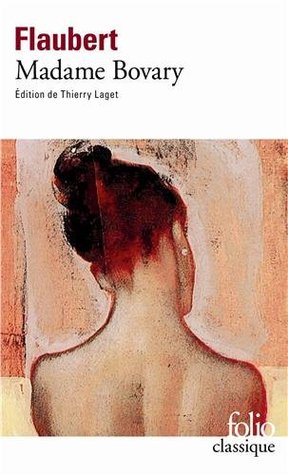
I learned that this book was prosecuted in 1857 against public morality. Probably they were not yet ready to accept literary realism or to accept ‘so-called’ literary modernism as they say it, portraying the unorthodox and bold decisions of a woman, in glorifying manner, especially when these decisions are related to her desires and sensuality. Just as a matter of fact, almost during the same period in India, there was something similar occurring in literature. The first ever novel in the English language in India was written in 1864 by Bankim. The title was ‘Rajmohan’s wife. It was also considered a bold work from the point of view of the emergence of modern women of 19th century India, who boldly fought for her individuality and fell in love with her brother-in-law, though she was not as controversial as Madame Bovary.
“Before marriage, she thought herself in love; but the happiness that should have followed this love not having come, she must, she thought, have been mistaken. And Emma tried to find out what one meant exactly in life by the words felicity, passion, rapture, that had seemed to her so beautiful in books.”
It’s very tough to give a mandate on such an issue, which is sensitive, treacherous, and heart-wrenching all together at the same time. I don’t think my opinions on the matter will really count, so I would rather like to talk about the craft of the author than the conditions of our heroine Emma. When at the beginning of this book I saw, those illustrations of a classroom, the entry of Charles as a student, and the funny mockery of his character in the language of Flaubert, I became nostalgic. How matching is the sentiments of the school-going days, and how similar was that depiction to that of ours, irrespective of the geographies and time period. 150 years later, those emotions swam on the lake of reminiscences of my own school days; holy, guiltless, and squeaky clean!
“His hair was cut square on his forehead like a village chorister’s,”
Flaubert’s descriptions of a given event were remarkable, at almost all places in the plot and I delightfully enjoyed it. Another interesting factor was the song-like, musical sort of continuation, in the sentiments of the characters. The harmonious nature of this prose was further enhanced by those well-embedded dialogues. And this is one of the reasons I’ll rate this book high.
As the story gathered pace, from childhood to adulthood; Charles grew up and one day entered his life, Emma. In fact, there is more than one ‘madam Bovary’ in the plot so a new reader can get muddled in the beginning. Emma is the real madam Bovary. This will be a discovery for a novice reader for sure.
“One day, when, in view of her departure, she was tidying a drawer, something pricked her finger. It was a wire of her wedding-bouquet. The orange-blossoms were yellow with dust and the silver-bordered satin ribbons frayed at the edges. She threw it into the fire. It flared up more quickly than dry straw. Then it was like a red bush in the cinders, slowly devoured. She watched it burn. The little pasteboard berries burst, the wire twisted, the gold lace melted; and the shriveled paper corollas, fluttering like black butterflies at the back of the stove, at last flew up the chimney.”
Certainly, this book was not the story of Charles, but this book starts with Charles’ case; how he grows and how he does his things in his own way, once Emma enters, the story becomes her. But when I ended the story, I at once understood why Flaubert began this story as the story of Charles, as it was he whom I sympathized with at last. The poor fellow, Charles Bovary! … ‘Charbovary!
When Emma succumbed to the overblown charm of that womanizer Rodolphe, I also remembered Shakespeare’s A Lover’s complaint,
‘O, that infected moisture of his eye,
O, that false fire which in his cheek so glowed,
O, that forced thunder from his heart did fly,
O, that sad breath his spongy lungs bestowed‘
Emma represented that typical existential frustration to me which I have found in many novels written in the same period, this French frustration was no different from the Russian existential agony. This woman’s sensual and fantasized idealism can not be compared with the nihilism of young man Bazarov of Turgenev’s, but are not both these characters spreading out from the same borehole of inner hollowness?
19th Century 20th Century Adventure Africa American Asia Booker British Literature Children Classic contemporary Crime Detective Drama Essays fantasy French Literature German Literature Gothic Historical Fiction Horror Humor India Indian Literature magical realism Memoir Music Mystery Nature Netgalley Nobel Prize Non Fiction Novel Novella Philosophy Play Poetry Race Romance Russia Russian Literature School Short Stories War Women

 BOOKBROODER