Why should you read Midnight’s Children?

Photo by Francesco Sgura on Pexels.com

“That’s how it was when I was ten: nothing but trouble outside my head, nothing but miracles inside it.”

Years ago, I read Midnight’s Children. At that time I became a fan of Salman Rushdie’s writing style. His style was new to me and though I struggled a little bit with the prose, I still liked it. The word magical realism was not a new thing for me. Before Salman Rushdie, I had already read Ben Okri and Gabriel Garcia Marquez. As time permits, I have decided to talk about some books, I have read in the past.

I will begin with this one, Salman’s writing has both flavors; comical and sobriety. But I found him sober, that too in a very jocular way. He wrote funny sentences and made me laugh many times. His selection of words was also very emphatic and playful.  I have found in the writing of Salman, ‘passion and pace’ both hand in hand. His passionate sentences, saying so many things all at once, packed together in long paragraphs which I felt sometimes, conveyed more to the reader, than what they were framed for. Some sort of- an overdose of literary pills, fed to a curious reader.
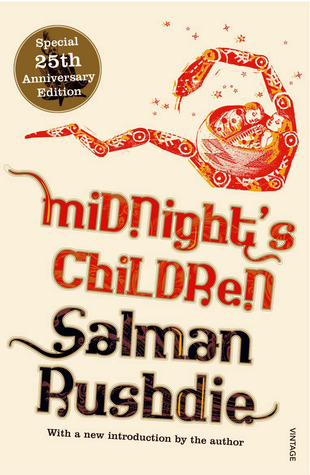
This is interesting to know that in 1993 this book was adjudged the “Booker of Bookers”, the best novel to have won the Booker prize in its first twenty-five years, It is claimed. How could I have grasped this thing at that time as my experience with the booker winning books has not been great so far! So, I will reserve my opinion on that but I must say that this book is an amazing book. Even if I found at some places, an inherent absurdity in the storyline, the imagination of the author and language was too exotic for me. I loved reading those passionate long paragraphs. The book was a wholesome cuisine for a hungry mind!

The other thing that I liked in the book is its politicization with respect to India’s certain socio-political history. It has broadened the horizon of the novel. And I am quite sure due to this amalgam, this book stands out. The author says in the beginning, that from the advanced money of his first novel, Grimus he decided to take a tour to India, and during the fifteen-hour bus ride the idea of midnight children was born, The year was 1975 and India had just become the nuclear superpower. So it inspired him to take up an ambitious plan to associate modern Indian history with the birth of a child.

“All games have morals and the game of Snakes and Ladders captures as no other activity can hope to do, the eternal truth that for every ladder you climb a snake is waiting just around the corner, and for every snake a ladder will compensate. But it’s more than that no mere carrot-and-stick affair because implicit in the game is the unchanging twoness of things; the duality of up against down, good against evil the solid rationality of ladders balances the occult sinuousities of the serpent in the opposition of staircase and cobra we can see metaphorically all conceivable opposition Alpha against Omega, father against mother here is the war of Mary and Musa and the polarities of knees and nose… but I found very early in my life that the game lacked one crucial dimension that of ambiguity – because as events are about to show it is also possible to slither down a ladder and climb to triumph on the venom of a snake… Keeping things simple for the moment however I record that no sooner had my mother discovered the ladder to victory represented by her racecourse luck than she was reminded that the gutters of the country were still teeming with snakes.”

MIDNIGHT CHILDREN

Those who live in the Indian subcontinent, or know well, its socio-cultural fabric and those who are aware of the politics of post-independent India, may feel a tie-in. Rushdie, with his passionate phrases, tried to narrate a magical story that is associated with the birth of a nation. He has portrayed some wonderful imagery beginning from Kashmir and then of his Mumbai days, the plot simultaneously traveling back and forth from Rawalpindi to Mumbai, involving the Pakistani army and India – China rivalry. The story is that some children are born near midnight of the day of independence of India and they all have magical powers. Salim Sinai, the narrator, is one among other 1000 children and he can read what is going on other’s heads, later got extraordinary power of smell.

“I tried to classify smells by color-.. I also had a geometric system: the roundness of joy and the angularity of ambition; I had elliptical smells, and also ovals and squares…”

 I consider this book a significant add-on in my readings and enjoyed it most of the time. I will give the book full marks for its language, fancy, and temper. One should try this book once in one’s reading life because the book is so much of many things. The author has swaddled all masala tightly for the reader in his splendiferous technique.

Finally one rider, the book is bulky and it’s definitely not an easy read. I remember I had also tried it at least three times before finally gaining the momentum to finish it. So there are high chances that some people may take exception to this book for these two reasons!

“One peeps out of you and you are off to the guardhouse. If you want to stay, stay mum. Got it?”
“What’s real and what’s true aren’t necessarily the same.”


― Salman Rushdie
“Most of what matters in our lives takes place in our absence.”


― Midnight’s Children.

If Your name is red, My name is blue!

Photo by Maria Orlova on Pexels.com

Even if you are away from your lover if a lover’s face survives emblazoned on your heart, the world is still your home.

An Impetuous response In October 2019
——————————————————————-
If your name is red, my name is blue.
You can glide from my hand like sand; I will stick on your soul like glue.

This book is dispersed with such a sumptuous redness that after reading it my entire self was tinged with azure… Not with red but with azure… because the color changes color when it evaporates from the pages of a marvelous book and transpires into the imaginary eyes of a curious reader. I am beholden. I have turned resplendent, but not like you… O Redness! I admit that the shine is the virtue of the Sun and one name of the Sun is also red. But on the backdrop on which this redness sparkles, that since time immemorial is only blue!

A rapport was straightway established between your redness and my blueness. It was all at once since the very beginning when that corpse said

“I am nothing but a corpse now, a body at the bottom of a well. Though I drew my last breath long ago and my heart has stopped beating, no one apart from that vile murderer knows what has happened to me.”

The validity of that initial upshot is intact in March 2022
———————————————————————————————–
I jotted down these two short paragraphs immediately after I finished this novel in the month of October 2019. This book was sitting bolt upright on the shelf for more than six years. It’s today only when I am getting time to write this review, I am recalling all my personal associations with this book.

A memory
—————–
I had bought this book years ago at Mumbai airport. I was sitting with my colleague (My senior obvious at my work), with whom I was traveling for the first time. We never had any personal interaction. He was busy messaging someone on his high-end smartphone and I did not want to bring out my phone. So my eyes were attentively examining the disorderly commotion of fellow travelers. While waiting in the waiting lounge for quite some time in absolute quietude I turned to the other man and broke the ice, “Excuse me! I will buy something.” My senior at once replied pointing in a certain direction with his right thumb to me, “The bookstall is there!” I looked into his eyes in surprise, grinned like a Cheshire cat, and moved on. I was thinking to myself how this man knows that I want to buy a book and not a burger. We never discussed books! We were, first time together!

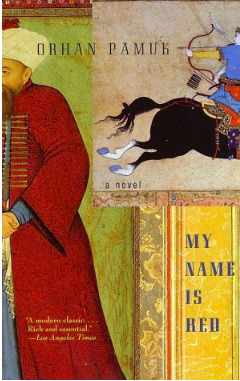
When I reached to the book parlor, my eyes fell on this title and this title seemed to me so quirky (How can someone’s name be red?) and when I read those lines stated by the corpse on the first page highlighted above, I bought it in a flash. I had not heard much of Orhan Pamuk then. This was probably the second book of my life which I immediately bought knowing nothing about the book and the author just by getting seduced by the title in a book outlet. The first such book was The Woman in White by Wilkie Collins. I am beaming to declare that in both cases my all of a sudden infatuation with the title of a book ended up in rip-roaring reading experiences.

However, every time I think about this book this question keeps popping up in my head,

“How did he know that I want to buy a book and not a burger?”

The book
—————–
Set in the Istanbul of the sixteenth century, this is a story of one ‘Black’ who after an absence of 12 years entered Istanbul, like a somnambulist, at the age of 36. He, 12 years ago had fallen helplessly in love with his young cousin. Many of his friends and relatives have died during this 12 years exile. Twelve years ago when he had declared his love for the Shekure, his declaration of love was considered an act of insolence by his uncle. He was exiled. He comes back and found that his love, with her two children, is living alone. Her husband, a soldier, has no clue of his whereabouts. And the brother of her husband, Hasan, has an evil eye on her.

While in the background, the Sultan commissions a great book secretly to celebrate his life and his empire, the work goes to the best miniaturists of the age. Meanwhile, one among them is murdered. As a consequence, in the foreground, it progresses as a story of a murderer, who feels and proclaims to the reader that he would not have believed he could take anyone’s life even if he had been told so a moment before he murdered that fool Elegant, who he feels was like a brother to him. He sometimes feels as if he has not committed any crime at all. He freely walks in the city of Istanbul, from one street to another looking at the faces of people.

As I stare at people’s faces, I realize that many of them believe they are innocent because they haven’t yet had the opportunity to snuff out a life. It’s hard to believe that most men are more moral or better than me simply on account of some minor twist of fate.

In essence, this book is a historical murder mystery. But there are so many themes and sub-contexts present. If you have encountered the term ‘postmodernism’ diving out from an edified tongue of a sagacious literary guy and you get confused what is this. Read this book, it is postmodernist in its approach, if I am not mistaken. Its meta-fictional traits are amazing and worthy of coming back to again and again.

This is a love story.
This is exotic and dreamy.

This is philosophical.
This is very reflective and ruminative in nature.

This is suspenseful.
I had to read it with bated breath.

This is about art and artists.
I saw the knack and prowess of the miniaturists.

This is about religion too.
Those ruminating parts in between are balanced on religion.

It plays wonderfully on human emotions.
That jealousy, that rivalry that romance, you will see.

You will also find real historical references and popular folklores and fables in the narration.

Personally, the most compelling things in this book for me were two.

The first one is the author’s take on art and artists in the plot. Miniaturists and calligraphers were frustrated by the wars and presence of Ottoman soldiers but hadn’t yet left for Kazvin or another Persian City from Istanbul and it was these Masters complaining of poverty and neglect, it was commissioned to inscribe illustrate and bind the pages of the manuscripts. While depicting their learning of art and getting mastery and describing the prowess of these artists, the author has sprinkled pearls of wisdom through his philosophical rumination at many places. I liked the conversations between masters and disciples and their thoughtful talks inside their artistic hovels.

I am delighted now to see that Black has acquired another essential virtue. To avoid disappointment in art, one must not treat it as a career. Despite whatever great artistic sense and talent a man might possess, he ought to seek money and power elsewhere to avoid forsaking his art when he fails to receive proper compensation for his gifts and efforts.

One student asked a question. My great master, my dear sir! what separates the genuine miniaturist from the ordinary?
Master responds that there are three traits.

Will he have his individual style?
-How will he feel when his work and pictures will be used in others’ books?
-Third virtue is blindness!

The second is the narration style of the novel with its suspense. Every major character of the novel narrates his or her story. The ultimate aim is to find the murderer. This murderer comes out in between and talks to the reader about how he did it and why he did it. But the reader is not able to guess who this bloody murderer is! In my opinion, this book is a must-read for every book lover. This is a scintillating blending of romance, suspense, history, art, and philosophy in a passionate and spirituous language of prose.

“People only tell lies when there is something they are terribly frightened of losing.”

― Orhan Pamuk