
While I was still wondering, what to read next, suddenly like a great sword of flame, a beam from the setting sun pierced my bookshelf, and smote upon the row, wherein was laid “She”, illuminating Ayesha’s lovely form, made on the front cover, with unearthly splendor. I picked it up, kicked off the dust from its cover, and read the introduction, the theme appealed to me and I decided it to be my next read.
It turned out to be a dreadful but enchanting experience when I finished it. Being one of the early works of fantasy literature, this has a sub-genre of adventure romance. Initially, it looked like an adventurous travelogue and too much expository but the story became immensely attractive when “She”, a two thousand years old sorceress, entered the story. I am sure her extraordinary portrayal by the author might have mesmerized its readers when it was first published in 1886.
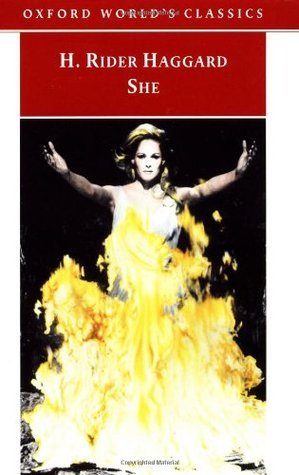
I thoroughly enjoyed the novel and I can easily perceive why this novel is counted among the highest selling novels of history. I appreciate the astonishing imagination of Haggard and his capacity to make very impossible-looking adventures appear real. The seductive Ayesha replicates the long-lasting fidelity to her husband and she is the embodiment of personal independence and her supreme authority over men.
A Cambridge professor Horace Holly and his ward go to the lost kingdom in the interior of Africa and there they unravel the mystery of ‘She’. See what the narrator felt of “She” when he saw her for the first time emerging from behind the curtain…
“The curtain agitated itself a little, then suddenly between its folds there appeared a most beautiful white hand (white as snow), and with long tapering fingers, ending in the pinkest nails. The hand grasped the curtain and drew it aside, and as it did so I heard a voice, I think the softest and yet most silvery voice I ever heard. It reminded me of the murmur of a brook.”
“say a figure, for not only the body but also the face was wrapped up in soft white, gauzy material in such a way as at first sight to remind me most forcibly of a corpse in its grave-clothes. And yet I do not know why it should have given me that idea, seeing that the wrappings were so thin that one could distinctly see the gleam of the pink flesh beneath them.”
“of a tall and lovely woman, instinct with beauty in every part, and also with a certain snake-like grace which I had never seen anything to equal before. When she moved a hand or foot her entire frame seemed to undulate, and the neck did not bend, but curved.”
A great read for those who have a taste of adventure, supernatural portrayals and have a propensity towards a mystic storyline. Sir Henry Rider Haggard was an English writer of adventure novels set in exotic locations, predominantly Africa, and the creator of the Lost World literary genre. He is very famous for ‘King Solomon’s mine’.
“Yea, all things live forever, though at times they sleep and are forgotten.”
― H. Rider Haggard,

 BOOKBROODER