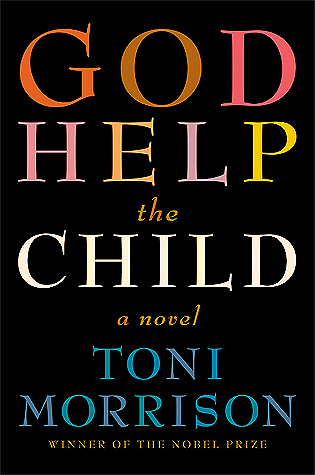
I like Toni Morrison’s prose. I still faintly remember some stuff from Beloved which I had flicked through years ago. After reading this book I have made a plan to revisit Beloved again. I have a copy. Her first novel, The Bluest Eyes is also in the race. There are these four lines on the first page of Beloved, that I have,
“I will call them my people,
Which were not my people
And her beloved,
Which was not beloved.”
It seems to me as if these lines carry forwarded to this book as well, in some sense.
Oh, God! Help the children!
The sad thing is that this turned out to be her last. Morrison’s writing is easy in flow and solid in structure. In this book too, I loved her prose, her sentences, her dialogues, and above all her hermeneutics! Those hermeneutics are brief yet stately!
Sofia Huxley was in prison for 15 years. Lula Ann Bridewell, also known as ‘Bride’ in the book, she was only eight years old when she lifted her arm and pointed her finger at Sofia in the courtroom. Bride was a witness. There was a case of child molestation; it remained a sort of mystery till the end. She comes out after fifteen years.
“She did do me a favor. Not the foolish one she had in mind, not the money she had offered, but the gift that neither of us planned: the release of tears unshed for fifteen years. No more bottling up. No more filth. Now I am clean and able.”
TONI MORRISON
But this book is not about a mystery nor it’s only about child molestation. Morrison has tried to achieve something else. I am aware that the racial divide has been a theme in her work. While searching about the authors, I sometimes come across various weird terms, especially those nomenclatures these literary people have coined. This time I came across a word called “black literature”. They said she brought the ‘black literature’ into the mainstream. Though I understand what they mean, I thought this term in itself is creepy. Our skin can be black or white or blue or green or whatever, but literature! Can it be black or white? Literature has only one name of the color, and that’s VIBGYOR. No one color! I am telling you. And this blend of all feasible colors is something that makes literature worthy to read.
Bride was a dark-skinned child of her light skin parents and she is the main character in the story. Bride grows up and becomes a successful businesswoman. She was moving on a highway in her Jaguar and met with a minor accident while speedily turning. She damages her ankle and stuck there. One little girl comes and then she brings with her one man. This man helps her come out of the crashed car and takes her home. There is his wife and this little daughter and they help and take care of her. She spends some weeks with her broken limbs there. And she is surprised by their unconditional help and care. This was one of the scenes in the book I liked.
“They had not asked her where she was from and where she was going. They simply tendered her fed her arranged for her car to be towed for repair. it was too hard too strange for her to understand the kind of care they offered- free, without judgment or even a passing interest in who she was or where she was going.”
GOD HELP THE CHILD
Booker was her boyfriend and one day he suddenly leaves her saying, “you are not the woman I want.” Booker had his own troubles as his brother was murdered when he was a kid. This relationship between Bride and Booker was very unforthcoming and both of them did not divulge some secrets and which made the relation erroneous and misleading.
There is a tone of constant sobriety throughout the book. It did not diminish for a moment for me; these modulations were not out of sight even at the moments of jubilation among the characters. This book is filled with tropes of women sensuality, gloom and obscurity, race discrimination, and child molestation. There are also falsehood, hurt, love and relationship issues. But I found the self-loathing and abandonment, through the Bride’s self-imposed narration, the two most dominant attributes of the entire plot. And Morrison has entwined them in a very suggestive manner.
Though I liked the book, the overall magic that I was expecting was missing. The story did not sprawl in the end. The book is fast-paced and its flow does not get interrupted at any moment. It was a bit perplexing in the beginning when I tried to acquaint myself with the characters. Once I knew who was who, It kept me bound all the time. This is the sad little story of hurt and sorrow- some long ago troubles and pain, life dumped on someone’s innocent soul! But its end was comforting. I liked the mild anarchy of the plot.
19th Century 20th Century Adventure Africa American Asia Booker British Literature Children Classic contemporary Crime Detective Drama Essays fantasy French Literature German Literature Gothic Historical Fiction Horror Humor India Indian Literature magical realism Memoir Music Mystery Nature Netgalley Nobel Prize Non Fiction Novel Novella Philosophy Play Poetry Race Romance Russia Russian Literature School Short Stories War Women

 BOOKBROODER