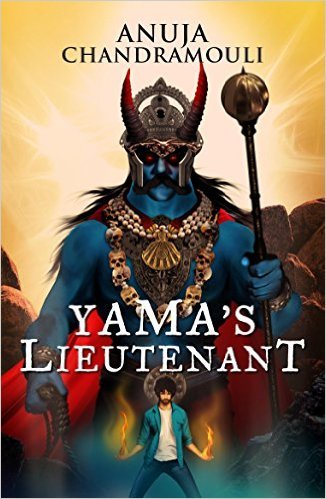
Read this young novelist from India for her craft and imagination:Anuja Chandramouli

“Chandramouli takes well-known stories… and retells them with great imagination and compassion”

NEW INDIAN EXPRESS

A few months ago, while walking alone in a newly inaugurated Mall in a city, unconsciously, under the impulse of an irresistible urge that usually occupies me very consciously, whenever I reach near a book shop, I once more entered into the shop in a temptation to know how would it feel to touch and see those new arrivals, and how would it feel reading a random page without any intention from those classics, which were obstinately placed on their respective shelves. Under the Indian author category, my eyes fell on the title Shakti: The Feminine Divine. After reading the blurb and a few paragraphs, knowing nothing about the author at that time, a thought came to my mind… …These crazy Indian writers! Every other guy is en-cashing on Indian Mythology nowadays. It seems it’s selling like sex here!


I put the book back in its place and after flipping through a few more books for the next half an hour, I came out with a Shakespearean tragedy in my hand. A few months later, when on one fine day I received this book and I strolled silently along with the story that began with portraying an emotional bond between two siblings Agni and Varuna, at one place I read, Varuna who wanted to be an author, saying this to her brother Agni about her book…

” But a little something about the book first…It’s about the Yama and Yami, the celestial twins. They have a few things in common with us (Duh! That’s why I picked them in case you were wondering and not because mythology is selling like sex nowadays) and I am sure you will learn to love them as much as I do! “

Wasn’t this an amusing coincidence? A fantasy writer explaining an unknown future reader, in a simple and straightforward way through the characters of her book, which this unknown reader never planned to read, solving for a quizzing thought that emerged within that ‘future-reader’s unknown mind on an unknown place! Who knows? A mythical fantasy author can have any sort of power these days!!

However, progressing through the plot slowly, I soon realized that Anuja is not just one more author selling those myths. She has something different in her craft that is distinctly her own. She has already made a place for herself with her first book Arjuna: Saga of a Pandava Warrior-Prince. I came to know her with this book based on the mythical Yama (The god of death). This book was a mighty writing dosage for me, a beautifully imagined story with a gripping narration and composition. I got very much impressed with the writing skills of the author, her potent and vivid imagination, spirited sentences and controlled flow in the story. In fact, I loved every single page from the writing point of view. Many a time I stopped and reread some of those paragraphs, thinking how effortlessly she has depicted her mental imagery with such an effusion.

Apart from the fantasy and thrill, An adherence was depicted in Agni’s association with his sister Varu that was in coherence with the relation between mythical characters Yama and Yami, and this pulled in some deeply woven emotions in this fantasy plot. Somewhere in the midway, more characters were introduced by the author, which elevated my interest in the story. The introduction of Minothi and Ganga’s daughter complimented the journey of Yama’s Lieutenant in fighting the evil forces. Some social issues have also been taken up by the author through her characters.

One major thing that I disliked as a reader was the binding constant pace of the plot. The story did not diverge in most parts of the book. What I mean by diverging is that every chapter seemed sort of complete in itself and as a reader I could not feel motivated many times to move to the next one, despite the fact that I thoroughly enjoyed each chapter. And what added to the strangeness of my reading experience was that this feeling of mine got reversed at last and I felt exactly opposite towards the end of the plot. I felt as if the author has left something to say and this book was not yet complete!

Overall I have enjoyed her wonderful writing more than anything else in the book and I am a fan of this prolific writer now, who has already written a bunch of mythical fantasies in a very short period. She definitely deserves the accolades and laurels she is getting. My final mandate is that if you have not yet read Anuja, just go and pick her book up. She won’t disappoint you!

19th Century 20th Century Adventure Africa American Asia Booker British Literature Children Classic contemporary Crime Detective Drama Essays fantasy French Literature German Literature Gothic Historical Fiction Horror Humor India Indian Literature magical realism Memoir Music Mystery Nature Netgalley Nobel Prize Non Fiction Novel Novella Philosophy Play Poetry Race Romance Russia Russian Literature School Short Stories War Women

Among the bevy of girls, there was a country hoyden!

“She reached the valley of the  Great Dairies, the valley in which milk and butter grew to rankness, and were produced more profusely, if less delicately than at her home- the verdant plain so well watered by the river Var or Froom.”

TESS OF D’URBERVILLES

Man’s intercourse with the world is malleable. It changes too fast. I can’t help it. It’s amenable to a great degree. Anything can affect you. You yearn for something else and end up doing something else. You appreciate this digression sometimes, and you inculpate yourself some other time.

I thought last year, I must take a four-hour road trip northward from Delhi and in no time I should reach the foothills of Himalaya; there I will put my feet up from this worldly affair; dunking my feet in the perennial waters. I would roll up my jeans up to my knee at the place where this perennial flow from the pinnacle of Himalaya just begins to pat the alluvial plane of India, and I would be throwing the pebbles into the stream, reading some of Keats, some of Emily Dickinson, with my eyes intently observing those clouds giving rise to various shapes above, ad interim. I would have preferred a rivulet rather than the main river for disentangling my encumbered thoughts. But the second wave of this deadly virus just curtailed all hope. Everything shut! I was stuck, neither in the capital nor in the lap of the Himalayas. I shrank on my table like a despondent lad.

As if a divine providence, Mr. Hardy came as my savor; though I was reading so many books together then, while dusting my book cabinet this book fell on the table and those attention-seeking eyes of the heroine of this novel’s cover page yelled over me in the very same way that buffalo of the Butcher’s crossing talked to me one day. Do you remember? And I read it. So in place of my going towards Himalaya, Mr. Hardy took me to London, and with a four-hour journey from London he accompanied me to this verdant valley of black more, and there I visited the village of Marlott. I also traveled back in time. It was 1890 now! There I saw, running among the bevy of girls, a country hoyden, as fresh as newly formed snow of Himalaya. Ah! Mr. Hardy introduced me to her. She is Tess. Tess of D’Urbervilles! Go meet her!

“Light broke through the chinks of cottage shutters when the shadow of the eastern hedge top struck the west hedge midway. She, being the most flexuous and finely-drawn figure among them all.

TESS OF D’URBERVILLES

I never knew this book would be as imposing. What a marvy prose I was reading, you can’t imagine, page after page I kept lumbering on, first slowly then fleet-footed. It was a rapturous ride. My bewildered face did not crease into the furrows of repugnance, not even for a second. When the innocent young Tess was trying to learn whistling the way it was desired by her mistress, she was trying to generate a hollow sepulchral rush of wind through her lips, and no clear note at all, I also whistled. I also remained fruitlessly blowing and blowing along with her. Neither she nor I generated a melody. But the mellifluous prose of Mr. Hardy was generating euphonies; tolling in our ears like bells.

 “She went stealthily as a cat through this profusion of growth, gathering cuckoo-spittle on her skirt, cracking snails that were underfoot, staining her hands with thistle- milk, and slug-slime, and rubbing off upon her naked arms sticky blights which though snow-white on the apple tree trunks, made blood-red stains on her skin; thus she drew near to Clare, still unobserved of him.”

THOMAS HARDY

What can be more coincidental than this that when I had not yet finished the book and a thought came to add a few lines of ‘Hardy – the poet’, and as soon as I opened a random page of the only poetry collection that I own of Mr. Hardy, the page number 94 I found these lines, I noted down and did not try to read other lines.

“At last one pays the penalty-

The woman – woman always do.

My farce, I found was tragedy

 At last!- one pays the penalty

 With interest when one, fancy- free,

Learns love, learns shame… of sinner two

 At last one pays the penalty-

 The woman-woman always do!”

-From the Coquette, and After (Triolets)

Oh! Poor Tess! What a story your was! I will not hint about the story, everyone knows that. It’s me who is 130 years late. My fault, but I will tip my hat with a broad smile and will thank Mr. Hardy for taking me back. I must say, everything was seraphic for me in this book. I took pleasure in language. That aroma of the village! That predicament of a young girl! My soul was fulfilled. I sometimes behave like this when I overplay with my feelings, but be assured I am not trying to gild the lily. The book is already beautiful. So beautiful indeed!

19th Century 20th Century Adventure Africa American Asia Booker British Literature Children Classic contemporary Crime Detective Drama Essays fantasy French Literature German Literature Gothic Historical Fiction Horror Humor India Indian Literature magical realism Memoir Music Mystery Nature Netgalley Nobel Prize Non Fiction Novel Novella Philosophy Play Poetry Race Romance Russia Russian Literature School Short Stories War Women