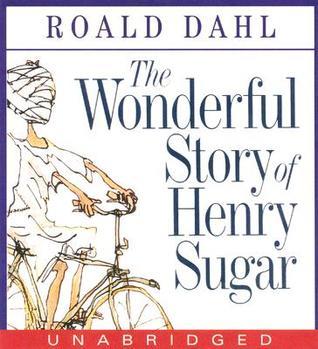
The Wonderful Story of Henry Sugar

This short story by the master storyteller proved to be a rejuvenating one for me. Henry Sugar is an interesting character but the more interesting thing happened to be the narration style of this story. It has been done peacefully well. I would express my experience with the book something like this; inside a story, there was another story. One story is wrapped in the second story. And then that second story was gift-wrapped in an embellished envelope which in itself turned out to be a story. In the end, I found myself reading the envelope for the nub of the story. Are you getting that?

I have read many stories of Roald Dahl and he is a twist-in-the-tale maestro. I was expecting something similar twist towards the end and I was ready for my share of those usual goosebumps but this time there was something else reserved for me. The story is about money and gambling and trickery and greed then this story is also about yogic control and meditation and focus and philanthropy. How these two different sets of human bearings go together here, among the same characters is the oddity of the game on the part of the author. The interesting part is that it traces its roots to India, and also mentions a place that is just a few kilometers away from the place I am writing this review, right now.

There are two spellbinding characters in this story. There is obviously the first one Henry Sugar, who is rich because he had a rich father and he has done never a day’s work in his life because he has invented a motto for himself,

“It is better to get a mild rebuke than to perform an onerous task”

He is 41, still unmarried because he is too selfish to share his money with his wife. This man drifts like seaweed across the globe. Such a wealthy man! Then this fascinating gentleman comes to know about the story of another compelling gentleman named Imhrat khan in Bombay whose introduction goes like,

“The Man Who Could See Without His Eyes”

One day, a doctor of the Bombay general hospital takes a roll of three-inch bandage and wraps it around this man’s head( Imhrat Khan’s) and this bandage holds a ball of cotton wool over his dough filled eye sockets so that this fellow could see nothing other than the top of his nose. He himself had suggested doctors do this so that he may look like a man without eyes in real, and then this man performs a miraculous performance in such a blind state in the Royal Palace Hall at night. Later after the revelation of the secret behind it, Henry sugar comes to know that this man had learned yogic techniques from a yogi of India, after years of practice of concentration he could see the other side of a card or could read a book put behind the metal sheet without seeing it just by touching the metal. Henry sugar decides to master the technique and he masters it quickly. He is one of the millions it seems. He also thought the same. When he learned it too fast. The chosen one!

And then begins this man’s venture. He takes a flyer with the casinos and gambling world and after winning a huge sum of money across the world with his power of “seeing which is not seeable”, he does so many unusual things. What does he do with that money and what happened to him after that? You should explore it for yourself. It’s a fascinating Roald Dahl style of storytelling on work, till the end. One can read it for a refreshing experience!

19th Century 20th Century Adventure Africa American Asia Booker British Literature Children Classic contemporary Crime Detective Drama Essays fantasy French Literature German Literature Gothic Historical Fiction Horror Humor India Indian Literature magical realism Memoir Music Mystery Nature Netgalley Nobel Prize Non Fiction Novel Novella Philosophy Play Poetry Race Romance Russia Russian Literature School Short Stories War Women

BOOKBROODER.COM

“Be not afraid of greatness. Some are born great, some achieve greatness, and others have greatness thrust upon them.”
― William Shakespeare.
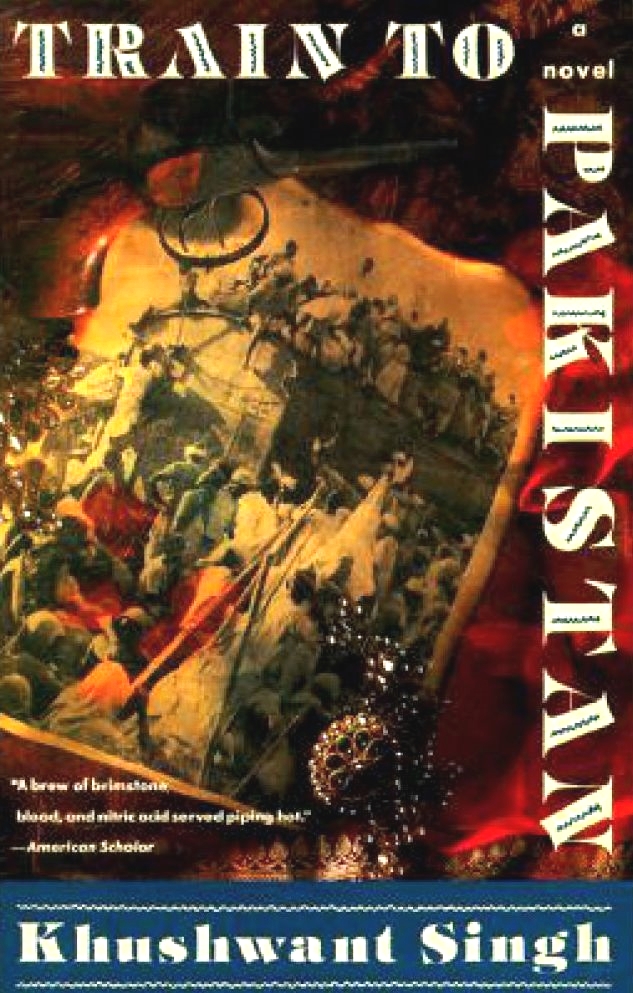
Never board on this train, but read this tale!

“The whole place was littered with men, women, children, cattle and Dogs. There were kites wheeling high up in the sky long lines of crows were flying from somewhere to somewhere and millions of sparrows tweeted about the trees. Where in India could one find a place which did not teem with life?”

TRAIN TO PAKISTAN

I read an article written by Khushwant Singh in a newspaper when I was very young. And I disliked the thoughts of the author, I remember. What was written in that article, I don’t remember! I only remember that I despised whatever was there. It’s an old case and my memory is not good. That article was also not in English.

But only sometimes back, I read the first few chapters of Khushwant Singh’s ‘Delhi’ and ‘I Shall Not Hear the Nightingale’ in a library for the first time and I was outright impressed with his writing skills. He writes in a very charming way. There is an inherent charm in his pen. Simple and binding! And today when I am finally reading his first book complete, I should claim that I thoroughly enjoyed both the plot and writing. The charm of his storytelling further prevailed.

This is a famous book in India and it begins in Bollywood style. A gang of dacoits enters a village at night, after looting the house, they murdered a man. The dacoits, gun firing in the air, creating dialogues in very filmy style! And another badmash named Jugga, making love with his lover at night, outside their houses in open! And when the gang of dacoits passes through the same place, he furtively sees their faces and recognizes them.

The time is near 1947, British have left the country and India has been partitioned into two nations. Mano Majra is a small fictional place at the border of India and Pakistan. It has only three brick buildings and one of them is of Lala Ram Lal and the other two are ‘a Sikh temple’ and ‘a Mosque’. Everyone lives there in harmony and there has never been a communal clash. One educated young man, well-read and studied in a foreign land, Iqbal comes to the village one day and stays at the Gurudwara. All villagers look at him with interest. He claims he wants to preach humanity and education or capitalism too. You’re ‘being illiterate’ is the cause of your grief, he preaches!

But local administration and police arrest him along with Jugga and put them behind the bar assuming both of them are involved in decoity and murder. They manipulate and try to misuse their authority for their own greed or unsolicitous interests. The educated man got irritated with the behavior of policemen and rebukes them.

“You just want to cover up your stupidity by trumping up a false case!”

 Time changed and one-day clouds appeared in the sky with hues of russet, copper, and oranges. And those who had fallen asleep had been prodded into getting up because one day a train comes in the station and it was filled with corpses, men, women, old, children some mutilated, some half dead, some packed lifeless among the luggage like a sack of cotton. The train had come from the Pakistan side. Magistrate witness this and become restless in the apprehension of the future of that small border village.

“The moth flew up again and down again. Hukum Chand knew that if it alighted on the ceiling for a second, one of the geckos would get it fluttering between its little crocodile jaws. Perhaps that was its destiny. It was everyone’s destiny. Whether it was in hospitals, trains, or in the Jaws of reptiles it was all the same. One could even die in bed alone and no one would discover until the stench spread all around and maggots moved in and out of the sockets on the eyes and get run over the face with their slimy clammy bellies.  Hukum Chand wiped his face with his hands. How could one escape one’s own mind!”

And then the administration or some machinery play with the emotions of the people of different religions and incite them to kill the people of other religion in the same manner they have killed the people of their religion on the other side. And after some reluctance, some refugees and the dacoits approve the plan. The innocent peasants and uneducated villagers just witness this vicious plan, vulnerable to their own existence! The author has made clever innuendoes through the dialogues of villagers, on effete elements of religions. I also liked the filmy bravery of Jugga Badmash portrayed by the author.

This book finished with some positivity though, and the climax of the book was succinct and well-executed, I loved it. This book gives a horrible account of the time when there occurred an exodus of people after the partition of India in 1947 from both sides. But the writing and storytelling of the author make it a very compelling read. You won’t find any intricacy that involuntarily presents itself whenever a story is based on a real historical misdeed. The prose is simple and binding and reverberation of dialogues, characters, and imagery of village life is also very natural. I found them unprocessed to the context of rural India of that time. Through the character of Iqbal, the author has been able to push a certain mindset of contradiction (of ‘hope and dilemma’ ) of the educated, modern young man of that time.

The condition has not much changed even after eighty years have passed. People still go fanatic when it comes to religion, they lose their sense, though they are well aware of losing it! 

Let kindness be the case everywhere! I hope.

“If you really believe that things are so rotten that your first duty is to destroy- to wipe the slate clean- then you should not turn green at small acts of destruction. Your duty is to connive with those who make the configuration, not to turn a moral hose-pipe on them- to create such mighty chaos that all that is rotten like selfishness, intolerance, greed, falsehood, sycophancy, is drowned. In blood, if necessary.”

19th Century 20th Century Adventure Africa American Asia Booker British Literature Children Classic contemporary Crime Detective Drama Essays fantasy French Literature German Literature Gothic Historical Fiction Horror Humor India Indian Literature magical realism Memoir Music Mystery Nature Netgalley Nobel Prize Non Fiction Novel Novella Philosophy Play Poetry Race Romance Russia Russian Literature School Short Stories War Women