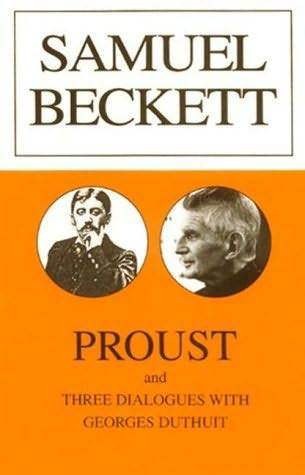
Samuel Beckett on Marcel Proust!

The Proustian equation is never simple.

This book can fulfill two purposes together. A glimpse of the writing of Samuel Beckett and, a thought on Marcel Proust! Is not this a great idea for those who do not know anything about the two masters? Something similar to killing two birds from one stone!

Proust’s The Captive, I had started last year and I could not move beyond a few pages, So I know nothing about Proust writing so far, Neither I have been able to properly start Waiting for Godot. I started reading both these books, but time failed me in both cases and both were kept dangling in my list.

But today I got in my hand, this book. Eager to know what one thinks about the other, I read it and it was a quite pleasing experience. It shaped my understanding of Proust. The beginning was like a typical essay. He talks about Proust’s memory and habits and writes,

Proust had a bad memory- as he had an insufficient habit, the man with a good memory does not remember anything, because he doesn’t forget anything.”

It has multiple references to Proust’s works. And the themes and philosophy, woven around all this make this reading not easy for a novice reader, but those who have read the majority of Proust’s novels will definitely find the critical take of Samuel Beckett on Proust very enlightening. Though I have not yet read Proust, this short book has given me some idea. I also saw Beckett’s capabilities as a critic.

His precision, in the scrutiny and breakdown of themes and notions, present in Proust’s work is commendable. I will recommend the book to those who are interested in reading a critical essay on one master’s work by another master!

19th Century 20th Century Adventure Africa American Asia Booker British Literature Children Classic contemporary Crime Detective Drama Essays fantasy French Literature German Literature Gothic Historical Fiction Horror Humor India Indian Literature magical realism Memoir Music Mystery Nature Netgalley Nobel Prize Non Fiction Novel Novella Philosophy Play Poetry Race Romance Russia Russian Literature School Short Stories War Women
“If a cluttered desk is a sign of a cluttered mind, of what, then, is an empty desk a sign?”

― Laurence J. Peter
“Do not fear to be eccentric in opinion, for every opinion now accepted was once eccentric.”

― Bertrand Russell

Father of free verse and Leaves of Grass!

Photo by Kaboompics .com on Pexels.com

O powerful western fallen star!

O shades of night- O moody, tearful night!

O great star disappear’d-O the black murk that hides the star!

O cruel hands that hold me powerless- O helpless soul of me!

O harsh surrounding cloud that will not free my soul.

LEAves of Grass

Last year, almost at the same time as now, I ordered the hardbound of three classic poets of the English language. These three books reached my place after two days. All were bulky and their hardcover was so exciting. After piercing through the packaging of the envelope, I touched all of them with reverence!

This book was one of the three books. I was reading Walt Whitman, in detail, for the first time. This is such a big book and there are innumerable poems in it. In fact, I kept on reading it, in parts, all year long. Initially, I could not match up with the tempo of the poems written. After the second or third reading, I was able to grasp. Poems in this book were being constantly added by Whitman, throughout his life, though the first edition was published in 1855, it is said that even before his death, he added a few poems in this book and kept revising it, up to 1891.

I found in this huge collection, the vigor of an ostentatious individuality and the love towards nature, sometimes he treats himself as a hero of epic in “song of myself”, other times, he boasts how he has seen all the world and geographies. These poems are political, social, personal, and sexual too in nature. In one part the autoerotic and homosexual poetry has found its place. He was a witness of the civil war in America (1861-65) and he has portrayed his expressions in some poems.

I liked the book. The artistic journey of the author in the exploration of self, and the way he has drawn up and compiled, the philosophy of life is highly commendable. He says like the autumn leaves fall and then again grow, death is also the regeneration of life. His poems are full of passion and they have momentum in them, as you read them, these lines gather pace of some sort, and you feel elated.

O such themes—equalities! O divine average!
Warblings under the sun, usher’d as now, or at noon, or
setting,
Strains musical flowing through ages, now reaching
hither,
I take to your reckless and composite chords, add to
them, and cheerfully pass them forward.

Walt Whitman

19th Century 20th Century Adventure Africa American Asia Booker British Literature Children Classic contemporary Crime Detective Drama Essays fantasy French Literature German Literature Gothic Historical Fiction Horror Humor India Indian Literature magical realism Memoir Music Mystery Nature Netgalley Nobel Prize Non Fiction Novel Novella Philosophy Play Poetry Race Romance Russia Russian Literature School Short Stories War Women