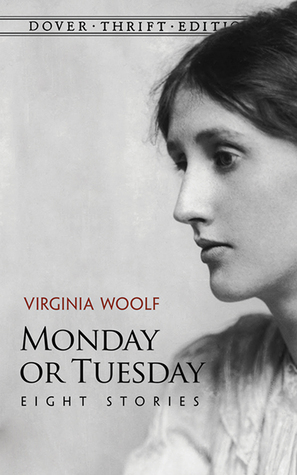
Oh, the brutes! It’s damnably difficult.
I have read novels of Virginia Woolf. That count goes to three. Three of her major novels four years back. I had opted to reserve my opinion on her writing for a very specific reason that I could not reach a well-defined conclusion then, and could not really spell out how her writing impacted me. Though I had loved all her books and rated them highly. You can say, I bifurcated my opinion in two parts, and rolled out one half in the form of ‘stars’ immediately then; and reserved the other half in the form of ‘reviews’ for the future. I think, now the time has come to bring forth the reserved half in such a language that is as simple as possible. This is the first time I am trying to talk about any of her books with a promise that I am going to revisit all of the above-mentioned ‘three novels’ this year soon. I am currently reading Jacob’s Room also, and it is adding up to my thoughts.
Now coming back to this book; it is a short story collection and I was reading her stories for the first time last year. How different a short story writer she is, to a novelist, I will expound a little bit.
This book has eight stories. But some of the stories are only one or two pages long. Ultra short version of the novelist I experienced. Comprehending those shortest ones was not easy for me. It required a greater level of concentration. You need some extra focus to keep up with her distinctiveness.
The first story is about ‘a Haunted House’ where a couple or you can say the ghosts of a couple safely move from one location to another investigating the locations and recalling their association trying to find out the hidden treasure. This is a symbolic one! The Other story is about the talk; discussions occurring in a society where many young women have sat and they are discussing various topics; book reading, about men, about judges, about war, about chastity, and about poetry, and books and different women have a different opinion. Can they ever have the same? The interesting part is the style of their conversation. I loved the non-identical style of the author.
I don’t think some of these stories are simple to comprehend. I am constantly repeating this; bear with my rumpus cry. I needed to read one sentence many times before I could sense what the author was trying to infer. Similar patterns, at many places, I was observing in her novels too. The story “Monday or Tuesday” is just one page long. But I read it at least four times to understand what it was all about. Lazy and indifferent herons she talks about in this tale. It looks poetic sometimes; philosophical the other time and the third time I thought it, even absurd. I mean… Not easy to grasp!
“Red is the dome; coins hang on the trees; smoke trails from the chimneys; bark, shout, cry “Iron for sale”- and truth?”
MONDAY OR TUESDAY
“An Unwritten Novel” and “The String Quartet”, are some of the stories that my brain somehow could lay hold of. In the story “Kew Garden” I saw an extraordinary style of portraying nature and it was very unusual. “The mark on the wall” is the last one and I witnessed her deciphering skills, and also her surveying capabilities in this story. Perhaps, I liked this story most in this collection. Her deduction through the prose like a mathematician, penning his hypothesis, was magical at many places. This book seems to be a collection of her experiments in her writing and she has achieved success in this.
If I could devise an award last year, I would have named it the “idiosyncratic prose award of the year” and this award would have been handed down to this book selected from amongst all my reads last year!
19th Century 20th Century Adventure Africa American Asia Booker British Literature Children Classic contemporary Crime Detective Drama Essays fantasy French Literature German Literature Gothic Historical Fiction Horror Humor India Indian Literature magical realism Memoir Music Mystery Nature Netgalley Nobel Prize Non Fiction Novel Novella Philosophy Play Poetry Race Romance Russia Russian Literature School Short Stories War Women
 BOOKBROODER