“Girls and boys come out to play
The moon doth shine as bright as Day
Leave your supper and leave your meat
And join your playfellows in the street
Come with whoop and come with a call
Come with a whole heart or not at all…”
Hey, girls and boys out there! Let’s talk about this stuff with a whole heart! The first thing that I caught sight of when I opened this book yesterday is this quote, on the very first page,
“I remember my own childhood vividly I knew terrible things but I knew I must not let adults know I knew. It would scare them.”
Maurice Sendak in conversation with Art Spiegelman, the New Yorker 27 September 1993
Doesn’t that quote give an eternal feel in this ephemeral existence that we are having on this planet? And the second thing, when I finished the book this morning and walked on my backside terrace with a cup of tea, I saw down there a puddle in the farm that was formed due to the leakage on that big flat plastic conduit that the caretakers of the farmhouse spread every now and then to irrigate their extensive farms. That puddle seemed to be turning into a river and I saw a few gigantic stones thudding its floor and a canopy of early morning fog over it filtering these thumping sounds from the bottom into melodious beats into the air.
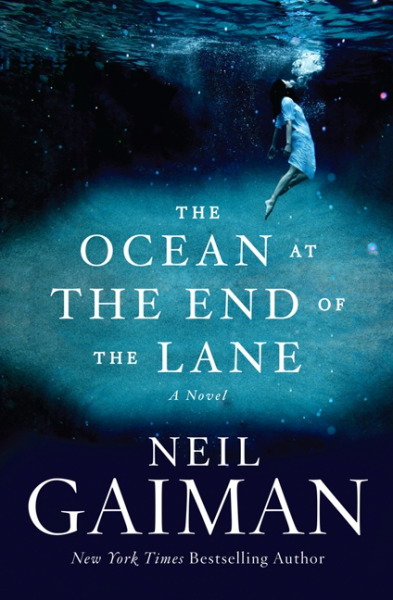
I read Neil Gaiman first time. There was a duck pond in the book and Lettie Hempstock said it was an Ocean but it was only a duck pond! A seven years old child asks his father what is the difference between the sea and the ocean and can a pond be an ocean. The father said that the sea is small and the ocean is huge and said that the pond cannot be an ocean.
The narrator of the story was a man who drove along winding Sussex Country Roads. There had once been a flint Lane beside a Barley field and the narrow Lane was with brambles and briar roses on its side. He reached a house and there tried to unearth the whereabouts of a girl Lettie Hempstock, who had an association with this man when he was seven and the girl was eleven.
The story begins with occurrences and eventualities in the life of a seven-year-old child and it remains rooted in a very small area near the pond and farmhouse. But within the first few chapters, I had already perceived that I was going to ride on the flamboyant fancy and preoccupations of unimpeachable minds of little children! You can imagine me a man who is in a brown study for some time! The sound within these innocent children emerged and reverberated around my place too and a distant connection to the other world was established.
“Small children believe themselves to be Gods or some of them do, and they can only be satisfied when the rest of the world goes along with their way of seeing things.”
That seven years old child had a dream and in that dream, some roguish elements stuffed some metallic thing in his throat and when the child wakes up from sleep he sees that something is really stuck in his throat and when he vomits, a coin pans out of his throat and he wonders how it happened. The other day an opal miner crushes his lovely kitten and he wanted to cry over her death but could not do so in the presence of everyone. Then this opal miner was found dead in the car of the child’s father and then there comes an adult girl named Ursula Monkton into the life of his family. And from here it begins the fancy and otherworldly affairs.
“…but when I looked at her image and her dress clapping in that windless kitchen clapping like the main sail of a ship on a lonely Ocean under an orange Sky”
Now I will come to the penmanship of the author. Though I did not find the novelty in the story, the prose is uncomplicated and effortless. The imagination and its emotional intervention in childlike innocence are very remarkable. This is something I will admire the author for. I could fancy almost every single scene in my head and at times I got Goosebumps. It becomes ghostly and seraphic both at the same time. I can remember many scenes for a long time I guess, in my head. In a scene, that child was inside a fiery ring where the condition was that if he will remain inside he will be safe from the monsters. And when almost everyone tempted him to come out of the ring, everyone came in disguise, in the form of his sister, like his father, but he did not move. The resolve and the faith of this seven years old in the words of his friend and savior were commendable, and that was an amazing scene! This book has been executed very well by the author.
There is also a self-possessed esoteric tone in the entire prose and I liked that. The conversation between the child and his savior who herself was a child, a powerful divine girl, has propelled me ahead in the plot. Magic realism is a word that is magical in its own sense. Horror and thrill were digestible.
“Adults follow path. Children explore. Adults are content to walk the same path hundreds of times or thousands; but it never occurred to adults to step off the path to creep beneath rhododendrons; to find the spaces between fences.”
What a sophisticated and elegant fancy, I just witnessed in this book!
It’s laudable!
19th Century 20th Century Adventure Africa American Asia Booker British Literature Children Classic contemporary Crime Detective Drama Essays fantasy French Literature German Literature Gothic Historical Fiction Horror Humor India Indian Literature magical realism Memoir Music Mystery Nature Netgalley Nobel Prize Non Fiction Novel Novella Philosophy Play Poetry Race Romance Russia Russian Literature School Short Stories War Women

 BOOKBROODER