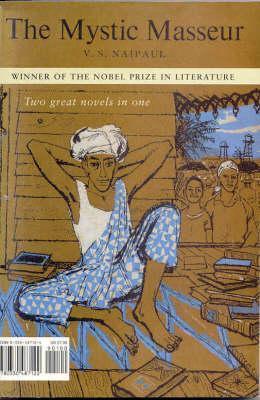
The Mystic Masseur by V. S. Naipaul

“This life is a funny thing, eh.” She said, “one day somebody dead and you cry. Two days later somebody married and then you laugh.”

I bear no ill-will for this book as I jumped over to it under the fit of a fizzing rage mixed with a sort of mental flurry that emerged in me out of sheer curiosity to read one of the earlier works of the author, which I had no plan to read anytime soon. This book was fun. Its comic sense, with conversation in the Trinidadian dialect of Indians living there of early 20th century, was very funny. Though I was not much impressed with the story, as being an Indian having familiarity with the theme of Indian ways and beliefs, used in the novel, a few events seemed very predictable.

This is the story of Ganesh, who fails in the teaching life in a small Trinidadian village and returns home where his to-be father-in-law Ramlogan is impressed with his reading and writing abilities and he calls him “sahib”. He wants him to marry his daughter Leela and he agrees. He uses the money of Ramlogan to build a library and orders thousands of books. There are some very funny and hilarious scenes created when the understanding between both of them was misconstrued due to the misinterpretation of certain events, in such cases the role of Leela was also very interesting, who becomes a communicator between the two and proves a canny as well as an untaught communicator at the same time.

Ganesh, a book lover, wants to do ‘a little bit’ of massaging and ‘a little bit’ of writings. As massaging he carries from his forefathers and writing from his own passion. After a lot of effort, he publishes a book on Hindu religion titled 101 Questions and Answers on the Hindu Religion. Among one of those questions, at one place, asks someone who is the greatest living Hindu? And the reply comes… Mahatma Gandhi! There was a lot of fun in all the delivery of dialogues. Later He sent a copy to Gandhi but the outbreak of the war prevented the acknowledgment. At least this excuse was given to all around him. Yes! This story was taking place in the 1940s. And the war was a world war!

One day he heals a boy of a young lady who injured his ankle and since that day he begins his reputation as a “healer”. He got popular and becomes a mystic. Later he gathers a mass of wealth and becomes a political leader.

This is an interesting book and I have no doubt about it. The story is definitely funny and worth reading for those who are not familiar with the beliefs and ways of Indian lives. Those might have found freshness in it at the time of its publication if this book was written keeping the prospect of Trinidad and nearby English-speaking population.

My problem was timing too. I was reading it after I have already waded through some of his major and well-appreciated novels written almost 20 to 25 years later than this book, so I saw a clear-cut difference in both the writing and execution. A writer matures with the time, but more important than this I found his writing changed both in style and approach. I could perceive these changes. This was indeed the first novel of the author. I guess he was writing it when he was 23 or 24 years old, so an impressive effort for that age. He is very humorous and entertaining in this book, and in his later works he became intense, but the origin of that impending intensity of thought could be felt even in this book as I noticed he had been mentioning here also both political and religious tenets, though in a farcical manner!

19th Century 20th Century Adventure Africa American Asia Booker British Literature Children Classic contemporary Crime Detective Drama Essays fantasy French Literature German Literature Gothic Historical Fiction Horror Humor India Indian Literature magical realism Memoir Music Mystery Nature Netgalley Nobel Prize Non Fiction Novel Novella Philosophy Play Poetry Race Romance Russia Russian Literature School Short Stories War Women
Oh! The good days! our farm sang from every corner !

I kept on scratching my head after finishing this book. My forefinger and middle finger drumming on my skull and a new sort of disconcerting bewilderment in my eyes!

This drumming was at once followed by the faint clanking of a loosely stitched steel button on my cuff which was vibrating with the tapping of my fingers generating a piece of harmonious music reaching to my eardrums. I must have been looking like a long-grey-beard crazy boffin inside his laboratory underground after an unusual result coming out of his experiment.

The reason is not that I did not understand the story, it was plain and realistic, but rather after finishing it and rummaging all my physical bookshelves and digital archives I have, I found that I had not one bit of Zola under my already-read docket. What does that mean? That means this was my first work of Zola! I couldn’t believe this. I was under the wrong impression that I had read Zola earlier and I was trying hard to track down what was that. But I found none. So whatever may be the case, I must tell that here in this story I liked his writing style and the way he has fast-moved his story. I am going to do a lot of French bookish activities this year and I think I am going fair. I had read a few stories here and there in past years and have not marked them down; I will try to make things more structured.

A 70 years old rich farmer named Louis Roubein is the narrator of this story. He boasts about the blessing and happiness and affluence, he and his family have gained at the beginning of the story

“Our house seemed blessed, happiness reigned there.
Oh! The good days! Our farm sang from every corner.”

THE FLOOD

Then on one mayday, there was considerable talk about the heavy rains of the past few days from the neighborhood. But this family head was confident that as long as the river did not overflow its banks, they have nothing to worry about. They console each other that nothing will happen, it’s, all the same, every year. The river becomes furious in the day and calms down at night.

When they were talking, a cry was heard from outside and they see through the window that two men and a woman with a child in her arm are crying, emerging from the side of the poplars, running in long strides. Initially, they couldn’t understand the reason for their fear as there was not a leaf moving. While they were just thinking there appeared like a pack of wild beasts speckled with yellow, coming from all directions, the crowding waves and a mass of foaming water shaking the roots on the ground with thundering gallops of their flock.

And here was the turn of this family to send the despairing cry now.

“Quick! quick! We must get into the house. Take refuge upstairs.”

Now the rest of the story, as you can perceive is about a devastating flood in the place.

There was an exclamation with a shriek with the word “Garonne! Garonne!” when those two men and a woman were crying running there. I first thought it was the name of some person, but I came to know then that it’s the name of the river in France around which this story has been told. I learned that this river has been flooding and devouring lives since old age and the story mentioned is based on reality.

Zola has written it at a very nice pace and the most important thing I noticed is the description style of the author. He says the entire thing happening there in a very precise and unambiguous manner, thus the reader moves to the next sequence at full tilt, leaving nothing behind except the footmarks of the continuity in the plot. The story is very realistic and has not left scope for a happy ending. Characters play real most of the time and at times were portrayed a bit more adventurous very common in a usual work of fiction but their culmination was brutally realistic.

A good experience with the author and an edification too for me.

My French list is thriving this year with Zola included in it now.

19th Century 20th Century Adventure Africa American Asia Booker British Literature Children Classic contemporary Crime Detective Drama Essays fantasy French Literature German Literature Gothic Historical Fiction Horror Humor India Indian Literature magical realism Memoir Music Mystery Nature Netgalley Nobel Prize Non Fiction Novel Novella Philosophy Play Poetry Race Romance Russia Russian Literature School Short Stories War Women