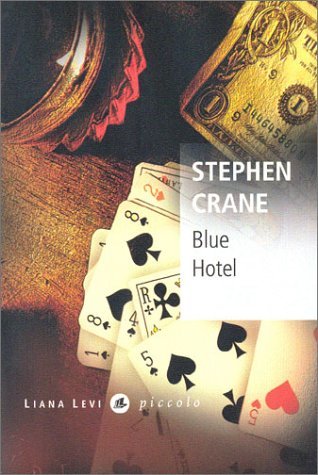
Blue Hotel: A story recommended by Hemingway

While reading this story, I was not aware of this fact. Now I came to know that this story was one of the two stories recommended by Hemingway to every young writer.

As they say, Stephen Crane’s fiction is typically categorized as representative of Naturalism, American realism, Impressionism, or a mixture of the three. Through this story of Crane, I tried to understand what the meaning of “Impressionism” was. This was a different sort of story for me. I can say a distinguishing one! I have mixed feelings about it.

First I was flowing with the story, It was a smooth effusion. The writing was good and the plot of suspense was fabricated very nicely, from the very beginning. I could feel an unrestrained expression of the emotion of five men inside a hotel, they were playing cards, a disorderly outburst or annoying tumult was felt by me through the characters of this story. The story was routine and the characters were being developed by the author with astute precision. Everything was perfect. I was getting into the plot.

But when I reached towards the end, my mind got embroiled into a state of commotion and confusion, the story took a different kind of turn and though things happened similarly as I was expecting but happened in a very unsubmissive manner!

And for that moment, very near to the ending of the story, Something happened and there was someone behind all the happenings. I did not really get the purpose of the story. Maybe my mind was not receptive to it.

But then there was a final paragraph of the story where it was stated that…

“Every sin is the result of a collaboration.”

And then I heard one of the five men, saying…

“Well, I didn’t do anything, did I ?”

And this way, Just after reading the final line of this story I found that it was a great story with a message! Did you get what I am trying to say? It was a great story!

19th Century 20th Century Adventure Africa American Asia Booker British Literature Children Classic contemporary Crime Detective Drama Essays fantasy French Literature German Literature Gothic Historical Fiction Horror Humor India Indian Literature magical realism Memoir Music Mystery Nature Netgalley Nobel Prize Non Fiction Novel Novella Philosophy Play Poetry Race Romance Russia Russian Literature School Short Stories War Women
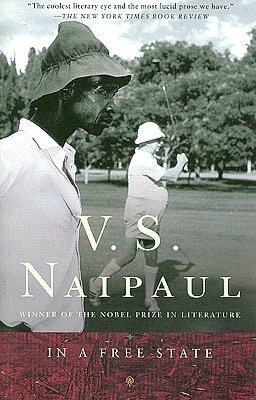
Once upon a time In a Free State

Bobby Said, “I never learned to drive until I came out here. But during my illness I always consoled myself with the fantasy of driving through a cold and rainy night, driving endless miles, until I came to a cottage and right at the top of a hill. There would be a fire there and it would be warm and I would be perfectly safe.”

IN a free state

Rain outside and fire inside that is always romantic!

In this book, the story gears ahead with the revving of an engine when a burst of blue smoke and squeal of tires are heard and there are a few places in this tale where skidding and slithering of this story come to a halt very much like when the back of car slaps a mound of earth going back in a cautious reverse gear.

Actually, it is about two expatriates, Bobby and Linda, driving across a nameless African country. The plot is set in Africa during the time when many of its countries were decolonized. This book can be picked up for two explicit reasons. First, it won’t take much of your time. This is quite small in size. Second, it’s a Booker award winner book of Nobel Laureate V. S. Naipaul. Naipaul said somewhere that this book was conceived and written during a period of intense personal depression that lasted two or three years. And it was his last such period afterward he was to know serenity. This book was probably one of his great works but I can understand after reading this book how that eternal period of serenity gave us this fine work and led the author to impart more poignant literature later.

This book depicts the chaos and frequent violence in a newly decolonized country; showing how young expatriates were attracted to these countries in search of expanded moral and sexual freedoms. It also shows how the English effect was persisting there even after their departure.

“The Africans drank shorter, prettier drinks with cocktail sticks and wore English-made Daks suits. Their hair was parted low on the left and piled up on the right, in the style known to city African as the English style.”

What I liked about this book is the precise writing style of Naipaul and the way in which multiple themes can be explored reading this book especially through the events and conversations during the car trip of Bobby and Linda. First, they found liberation and freedom of desire in this land but later at the time of tribal conflict and rage they were forced to take a long drive to safety!

I will recommend it to those who have not yet read anything from Naipaul. A good book to start with!

19th Century 20th Century Adventure Africa American Asia Booker British Literature Children Classic contemporary Crime Detective Drama Essays fantasy French Literature German Literature Gothic Historical Fiction Horror Humor India Indian Literature magical realism Memoir Music Mystery Nature Netgalley Nobel Prize Non Fiction Novel Novella Philosophy Play Poetry Race Romance Russia Russian Literature School Short Stories War Women