UNTOUCHABLE, A concern!

“He sniffed at the clean, fresh air around the flat stretch of land and vaguely sensed a difference between the odorous, smoky world of refuse, and the open, radiant world of sun. He wanted to warm his flesh; he wanted the warmth to get behind the scales of the dry, powdery surface that had formed on his fingers; he wanted the blood in the blue veins that stood out on the back of his hand to melt.”

untouchable

You know! In a memoir of his first story “Lost child”, Mulkraj Anand mentioned that he dared to show his story to Virginia Woolf. She asked him to read it out in her next home party. Desmond Macarthy, Victoria Sackill West, Edward Garnet, clapped after he read his story.

During that time, in one of her pamphlets, Virginia Woolf attacked many novelists like Arnold Bennet, H G Wells, John Galsworthy, for writing about the characters of sub- world. This shocked Mulkraj because he was planning to write this novel about the untouchable people. He was further demotivated when one of the young poets, after knowing that Mulkraj was going to write about his growing up years among tough boys, sons of bandsmen, washer men and sweepers, said, leave your Cockneys in their sordid world….As we ignore the Russian writer Gorky’s ‘Lower depths’; write like Laurence Hope about flowers in garden Shalimar!

Then coming back to India, Mulkraj wrote this novel under the guidance of Gandhi. Gandhi advised him not to use big english words and to use the local language.

This is story of a sweeper named Bakha, a young and intelligent character.
Through the ordeals and activities of life of Bakha, his family, his friends and other characters writer has given a wonderful but tyrannical imagery of those days when the untouchability was a great challenge in Indian society. He has depicted very artfully the conflicts between the high caste and lower caste people in the society and has finally reached to the argument that the untouchability was inhumane.

Bakha is a representative of down trodden in the pre-independent era of India. He suffers because of his caste and all the lower castes people are suffering because they are by birth outcaste. Writer has depicted the hypocrisy of the upper caste people that men like Pt. Kali Nath enjoy the touch of the lower caste girls, but do not treat lower caste people equally in other matters. He has exposed all this hypocrisy and double standards. Bakha has been portrayed as a universal figure to show the oppression, injustice, humiliation to the whole community of the outcastes in India in this book.

An attractively written story by Anand, proving a fact that social exclusion and exploitation of the subaltern is well rooted in the caste system of India !

An outcast was not allowed to enter into the house of higher caste, even when food was required in utmost urgency…

“For being an outcast he could not insult the sanctity of the house by climbing on the house on the top floors where the kitchens were, but had to shout and announce his arrival from below.
‘Bread for the sweeper mother bread for the sweeper,’ He called standing in the door of the first house. His voice died down to the echo of ‘thak, thak, thak’, which stole into the alley.
‘The sweeper has come for the bread, mother!” he shouted a little louder.
But it was of no avail.
He penetrated further into the alley and standing near a point where the doors of four houses were near each other, He shouted his call: ‘Bread for the sweeper, mother; bread for the sweeper.’
Yet no one seemed to hear him on the tops of the house.”

Untouchable

19th Century 20th Century Adventure Africa American Asia Booker British Literature Children Classic contemporary Crime Detective Drama Essays fantasy French Literature German Literature Gothic Historical Fiction Horror Humor India Indian Literature magical realism Memoir Music Mystery Nature Netgalley Nobel Prize Non Fiction Novel Novella Philosophy Play Poetry Race Romance Russia Russian Literature School Short Stories War Women
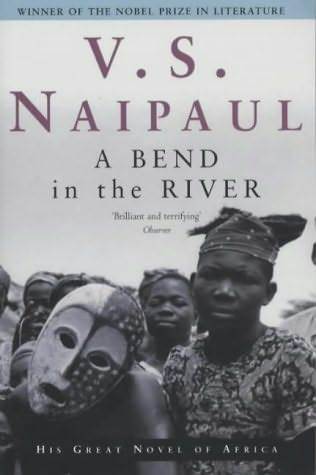
A Bend in the River by V.S. Naipaul

If I weigh up this book against the three major fictional works that I have read so far of the author I have found the writing of the author in this book a cut above the rest. Though I set foot into the V.S. Naipaul’s literary world first through his Booker-winning book In a Free State and Last year I read Miguel Street too, I found this book more appealing to me from a writing perspective. I am not considering the non-fictional work of the author for such a comparison. A few chapters from his India: A Wounded Civilization had some impressions over me already at a young age.

This book is not for all. There is not much excitement and thrill quotient to get into this book for a general reader. But here I must say that I read this book quite quickly and despite not having very compelling subject matter, I couldn’t put this book down. There is something in the writing of this book. I am not getting an unerring word to describe it but there was unequivocally something in the writing. Maybe I liked its contemplative and solicitous tone throughout. The writing was simple and no clichés have been used and it has a sort of sweep in the narration. A reader in me very much appreciates this sort of effortless and elegant narrative pattern. I could glide over it.

This book is written in four parts. The first part makes a backcloth for the entire novel in the form of introducing the characters. The narrator, Salim, is an Indian-origin man, living in the better part of Africa and setting his business there, He bought a shop from Nasruddin, and set his business there. Zabeth, a strong and fearless woman from the fishing community becomes her earliest loyal customer. Her character portrayal was amusing in the beginning. Her son is Ferdinand and he has been handed over to Salim for some time in his shop so that he may learn something.

The relationship between the characters has been set up very well, all major and minor characters I liked factually as well as emotionally. Here are very few characters in the novel. They are just six or seven. The build-up of relations among people who came together through a twist of fate or out of economic or colonial compulsion was nicely done.

“He was something of a palmist and his readings were valued because he could do them only when the mood took him. He was on a bentwood rocker, rocking unsteadily from the edge of the carpet to the concrete floor. He asked for my hand. He felt the tips of my fingers, bent my fingers looked briefly at my palms, and then let my hand go. He thought for a little about what he had seen. it was his way of thinking about what he had seen rather than looking at the hand all the time and he said, “you are the most faithful man I know.” this did not please me. It seemed to me he was offering me no life at all. I said, “Can you read your own hand? Do you know what’s in store for you?”

A Bend in the River

This book is about the constant fight of civilizations. It is also about exile and aspiration. The after-effect of colonialism in a newly independent state and the concept of emerging Africa have been explored through contemplative discourse by the author. It talks about the old Africa and a new world. Life opportunities for betterment within Africa and outside are a constant fight.
Nazarudin wants to leave for Uganda, for better prospects within Africa,

“Do you know Uganda? a lovely country. It’s three to four thousand feet up and people say it’s like Scotland with the hills. The British have given the place the finest administration you could ask for. Very simple, very efficient. Wonderful roads. And the Bantu people there are pretty bright.”

The book, in the latter parts, shows the effect of rebellion on the lives and economy of people settled there. The eastern part of Africa has been described in an indicative manner. Salim reaches to England and thinks there of his plans and prejudices,

“In Africa all the course I had paid attention only to one color in nature- the color of the sea. Everything else was just bush green and leaving for brown and dead. In England, I had so far walked with my eyes at the shop level. A town even London was just a series of street or Street names and Street was a row of shops. Now I saw differently and I understood that London wasn’t simply a place that was here as people say of mountains but that it had been made by men that men had given attention to details as minute as those camels.”

A BEND IN THE RIVER

When he returns, radicalization had occurred at his place in Africa. The businesses have been nationalized and he becomes the manager of his own business. A president is a powerful person. But power has been misused. At times, I found the story taking allegorical form and dictating the meaning and consequences of wrong politics in the name of making a new world, here the word ‘New Domain’ has been used by the author for those insinuations.

A very good reading experience from the writing point of view! I liked this book for one more reason…For its simultaneous portrayal of exile, aspirations, and corruption at both individual and political levels!

19th Century 20th Century Adventure Africa American Asia Booker British Literature Children Classic contemporary Crime Detective Drama Essays fantasy French Literature German Literature Gothic Historical Fiction Horror Humor India Indian Literature magical realism Memoir Music Mystery Nature Netgalley Nobel Prize Non Fiction Novel Novella Philosophy Play Poetry Race Romance Russia Russian Literature School Short Stories War Women