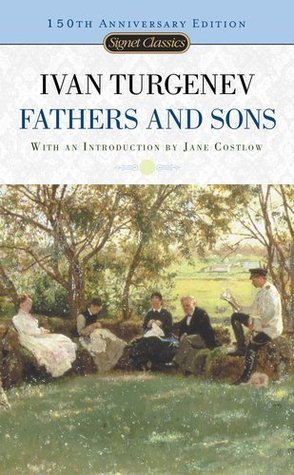
Fathers feel that they now belong to bygone times and sons feel that they have learned enough to indoctrinate new scientific theories and philosophies to the fathers. This happens today and this happened in this realistic classical work, based on the Russian society of the mid 19th century.
The story begins with two brothers. First one, Nikolai Petrovitch, who had lost his wife, but there remained a sense of well-spent life, as his son was growing up under his eyes and, second Pavel Petrovitch, on the contrary, was a solitary bachelor, who was entering upon a certain kind of indefinite twilight period of regrets that are akin to hopes, and hopes that are akin to regrets, when youth is over, while old age has not yet come.
On one fine day of May 1859, Nikolai receives his son Arkady, who has just finished his graduation from the University of Petersberg.
“So here you are, a graduate at last, and come home again,” said Nikolai Petrovitch, touching Arkady now on the shoulder, now on the knee. ‘At last!’.
Fathers and sons
Here comes the most interesting character of this novel Mr. Bazarov, who is a friend of Arkady and has returned with him. He stays at the estate of Arkady’s father for some time before going to his own family place.
Bazarov a very clever and intelligent young man who has a strong sense of conviction and aggression about his thoughts and words. He scorns art, family life, and women. He is representative of the theory of Nihilism. I did not know if this concept of nihilism was already popular at that time in Russia or was made popular by Turgenev through this book. Then I learned that the epithet of nihilism was in use since 1829 and this book only extended its interpretation.
Bazarov does not believe in anything. He only believes in himself. He is cynical about his love affairs and he does not at all care about paternal tenderness. One day he sees the father of Arkady reading Pushkin and he says to Arkady…
‘The day before yesterday I saw him reading Pushkin’, Bazarov was continuing meanwhile.‘Explain to him, please, that that is no earthly use. He is not a boy you know; it’s time to throw up that rubbish. And what an idea to be romantic at this time of day! Give him something sensible to read.’
Fathers and sons
‘What ought I to give him ?’Asked Arkady.
‘Oh, I think Buchner’s Stoff and raft to begin with.’
Bazarov is full of scientific theories and he has plans for the mankind and for lower classes but Pavel Petrovitch, an uncle of Arkady, slowly inculcates the vehement feeling of contempt to Bazarov, because of his nihilist ideology, which somewhere in the middle of the story, takes the form of a very unnecessary and egoistic clash in the form of a duel between them. This classic story moves ahead in style and covers multiple themes and contexts.
I came to know that Turgenev was an enthusiastic hunter and it was his experience in the woods of his native province that supplied material for ‘A Sportsman’s Sketches’, the book that had first brought him a reputation. I have not read it yet, however, I witnessed a different sort of hunting abilities of the author in this book. He has hunted the prevailing belief and order through his character of Bazarov, whom he has made so strong that all existing philosophies die away in front of him. You may not like him for his rudeness and crudity but you would certainly get impressed by his astonishing brilliance.
I got a wonderful picture of Russian society, of its aristocracy, of its middle class and of its peasantry life. The content of this book is very rich in its prose and style. I read two different translations of this work. I enjoyed both. I found nothing unnecessary in the plot, one thing complemented the other. Conversation among the characters is extremely lively and at those places, I was nearly absorbed with the characters and ambiance. Though he has not created any dominated woman character here, the fancy towards young girls is well depicted. Conflict of personality in male characters and struggle against ‘the clutches of circumstances’ among female characters can be felt at many places.
As a reader, I can not be more satisfied when I find the characters of a book so real and engrossing that they go directly into me and get embedded somewhere within me with their own viewpoints and tenets. I would very much like to read more of this great writer, I have already enlisted some of his major works.
19th Century 20th Century Adventure Africa American Asia Booker British Literature Children Classic contemporary Crime Detective Drama Essays fantasy French Literature German Literature Gothic Historical Fiction Horror Humor India Indian Literature magical realism Memoir Music Mystery Nature Netgalley Nobel Prize Non Fiction Novel Novella Philosophy Play Poetry Race Romance Russia Russian Literature School Short Stories War Women
 BOOKBROODER