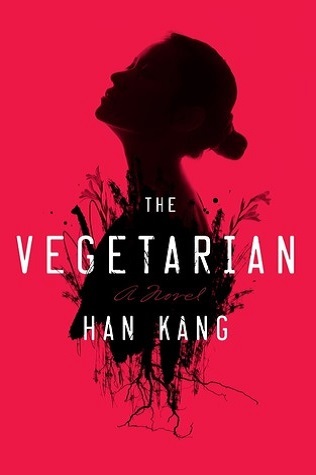
What to watch? The Vegetarian? No! Read it!

My goodness! What a deceptive title! The vegetarian!
It’s spurious… but not in a negative sense. This book consistently played with my thought process as I progressed with the book.

After the first few chapters, that is, in part one of the book… I thought, I’II will do some fact-finding galore on the internet on a vegetarian diet after having finished the book and will write them in my review.

Then the middle chapters, that is, in part two of the book…. I forgot about the diet and this book just began seducing this reader by playing with his testosterone in the guise of an artistic endeavor between a male and a female body. This part filled absolute sensuality in the whole body of this reader. In mind too… Oh! What an act of betrayal… taking place simultaneously in the book as well as in my mind.

Then the final chapters, that is, in part three… the book gracefully turned me serene, depressed, motionless, flummoxed, and thoughtless.

And when it finally ended, I found myself alone, sitting quietly on my terrace, in this afternoon when the sun is shining over my head, but still, this cool gust of foggy winter afternoon filling me with shivers, as if damping down the fire in me, the fire that was ignited by the idea behind the book. I was thinking, without any quivering of my mind at least for the next few minutes, observing the world outside… what was that? What this book tried to convey? Reverberating in my head are these lines…

“I don’t know why that woman is crying! I don’t know why she keeps on staring at my face either, as though she wants to swallow it or why she stroked that bandage on my wrist with her trembling hands?

My wrist is OK! It does not bother me. The thing that hurts me is my chest.
Something is stuck in my solar plexus. I don’t know what it might be? It lasts there permanently these days. I can feel this lump all the time. No matter how deeply I inhale, it does not go away. Yells and yells credit together layer upon layer are meshed to form that lump.

Because of meat.

I ate too much meat. The lives of animals I ate have all lodged there. Blood and flesh, all those butchered bodies are scattered in every nook and cranny. And though the physical reminiscences were excreted, their lives still stick stubbornly to my inside.”

the vegetarian

If you ask me what was my takeaway. I will say IMPACT. This book impacted me. This impacted me differently. So this book is DIFFERENT too.

The central character of this book is a woman, perhaps living somewhere in Korea. She was introduced by the narrator who is her husband as “an unremarkable lady”. Her husband introduces her in a bad light and reveals her wearing secrets to the reader. I thought in the beginning that this man should have introduced her in a little more dignified way to the reader. After all, she is his wife. A reader in me had an objection to this introduction initially. But that was probably a prologue to such a queer character into which his wife was soon going to turn into. She decides to stop eating meat suddenly one day after a nightmare. Her family does not want her to stop it. Was it a societal norm? I don’t know. People living there may justify it. She faces violence. The most violent act that I felt in the book was the act when male members of her own family (her father’s side) slap her and force-feed her a piece of pork. She retaliates and cuts her wrist in return, creating a sudden panic in the family.

This book though looks like something about advocating a vegan diet. It’s not only so. It’s something else too. It’s about women; it’s about women’s body and their desires. It’s also about sexuality and is harshly sexual midway. It’s about violence and mental illness. It’s also about hallucination. The narration is powerful. It grips you really hard. It reaches into you. You can feel the undercurrent going on there. This book is also about a rare thing. That rare thing is turning off the body of a woman into a plant…or into a tree! What is this? Is there something magical there in the book? No. It’s not magic. It’s a sort of mental delirium. But the author of this book said somewhere that she was inspired by this idea only when she started writing this book… the idea of a woman turning into a plant.

So it’s obviously a different sort of experience. Quite a blunt one!

Oh! I forgot to mention that Mongolian mark there!

19th Century 20th Century Adventure Africa American Asia Booker British Literature Children Classic contemporary Crime Detective Drama Essays fantasy French Literature German Literature Gothic Historical Fiction Horror Humor India Indian Literature magical realism Memoir Music Mystery Nature Netgalley Nobel Prize Non Fiction Novel Novella Philosophy Play Poetry Race Romance Russia Russian Literature School Short Stories War Women
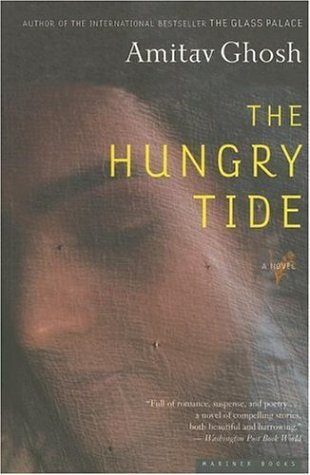
The Hungry Tide by Amitav Ghosh

“The true tragedy of routinely spent life is that its wastefulness does not become apparent till it is too late.”

The Hungry Tide

This quote does not reflect the theme of this book but it caught my eye in this green-covered book in my hand when today I was flipping its pages thinking what to write about it.

It’s tea time and there is a tray ready on a side table with two pieces of cookies. A squirrel on the wall of the garden is eating something in a ravenous way. I have no idea what is that something, it’s scanty for my eyes, but it must be something very delicious which can be assumed by observing the way this little creature is feeding itself, using both its hands fleetly and effectively.

In fact, for the past few days, I am routinely spending my time this way only, in the evening. A finished book in my hand at tea time… I, thinking something to write about it. Two routinely placed cookies on the side table… A squirrel doing something always on the garden wall and then me postponing writing about the book for one more day. But this quote surprisingly worked as a catalyst today motivating me to write a review as it evoked the sentiments of this mentioned wastefulness in me and I quickly decided to talk about the book here before it’s too late.

So…Talking about the book, Piyali Roy (Piya) is an Indian-origin American cetologist. She studies marine mammals. She comes to India near her ancestral place in the hope to get a permit to do a survey of marine mammals of Sunderbans.

Kanai, who thinks that he has the true connoisseur’s ability to both praise and appraise women, spots her, the moment he reaches onto a crowded platform. Inside the train coach when she was trying to maneuver the cup of tea from the tea seller through the bar of the window then this man (Kanai) sitting opposite to the seat of Piya, suddenly flips over a page. With the jolting of her hand, she tries to make sure most of the tea spills out of the window but she could not prevent a small trickle from shooting over his papers. With a mortified sorry from the Piya there begins the interaction between the two and with their acquaintance begins this exotic tale from the pen of Amitav Ghosh. She does her research and Kanai translates for her some critical things facilitating her understanding of local ambiance and culture.

This story takes the reader on a trip to the long chain of the archipelago of the Bay of Bengal. It talks about the ways of boatmen in the region. It’s an adventure read for lovers of the sea and riverine adventures, loaded with some interesting real facts and some interesting myths that prevailed in a specified area of Bengal.

The story moves in time and space. The characters of the present time are Kanai, Fokir, and Piya and the main character of the past is Nirmal. Intricacy and suspense in the plot are kept in the old diary of Nirmal, which is read by Kanai to connect the dots of events. Amitav has touched on many issues like refugee, freedom, war, government, and tribal conflict, ecology, marine life and lives in seaside habitats in this book.

The most beautiful part of the story for me was the reticent and self-effacing bond between Fokir and Piya. Piya is an educated English-speaking marine biologist and Fokir is a local boatman who knows the only local language, He does not know what she says and she does not know what he says. He saves her life in the early part of the story and then plays a crucial part in the latter part of the story. The restrained communication of emotions between the two despite the language barrier provides the real delight in this story. It was symbolically written and crafted by Ghosh in a very alluring way.

“What was he thinking about as he stared at the moonlit river? The forests, the crabs?

Whatever it was she would never know: not just because they had no language in common but because that was how it was with human beings, who came equipped as a species, with the means of shutting each other out. The two of them Fokir and herself, they could have been boulders and trees for all they knew of each other: and wasn’t it better in a way, more honest, that they could not speak? For if you compared it to the ways in which Dolphins’ echoes mirrored the world, speech was the only bag of tricks that fooled you into believing that you could see through the eyes of another being.”

In my sailing through this beautiful story, I also encountered some well-researched scientific facts about mammal creatures and about the history of those small islands in the Bay of Bengal. The mixing of faith and mythical belief in the story made it more interesting for the reader. Ghosh has tried his best to keep the story equally relevant for both the native readers and for the general English readers and he has done it quite successfully.

One other important thing that happened to me while reading this book.. somewhere in the latter half Ghosh has tried to translate a mythical story through one of his characters and while reading two pages of that chapter completely which was certainly looking similar in structure with the previous prose style, I suddenly found that there was something rhyming and verse like there, I flipped back and rereading those paragraphs again, realizing this time that Ghosh has deliberately and wonderfully created an English pastiche of the Bengali metre dwipadi poyar: a rhymed couplet of about 12 syllablesIt was a really wonderful thing in the book. An English reader can have a feel of a mythical poem keeping with its essence in the original form. It was fun reading and knowing about it.

A fulfilling reading journey for me with such fascinating penmanship of Ghosh.

19th Century 20th Century Adventure Africa American Asia Booker British Literature Children Classic contemporary Crime Detective Drama Essays fantasy French Literature German Literature Gothic Historical Fiction Horror Humor India Indian Literature magical realism Memoir Music Mystery Nature Netgalley Nobel Prize Non Fiction Novel Novella Philosophy Play Poetry Race Romance Russia Russian Literature School Short Stories War Women